IMF programme no excuse to retard growth: PM Shehbaz


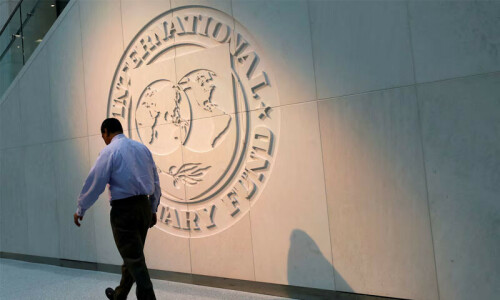
Prime Minister Shehbaz Sharif on Tuesday said that any upcoming programme with the International Monetary Fund (IMF) could not be used as an excuse to retard the country’s economic growth.
The government has already announced that the matter of an Extended Fund Facility (EFF) with the IMF will be discussed in Washington next month as the country looks to alleviate a full-scale economic crisis.
The standby $3 billion arrangement with the global lender expires on April 11, and the two sides reached a staff-level agreement regarding the disbursal of the final tranche of $1.1bn earlier last week. PM Shehbaz, after being sworn in for a second time, had directed his finance team to begin work on seeking an EFF from the IMF.
Addressing a ceremony in Islamabad today, the prime minister reiterated that the country could not survive without another IMF programme. At the same time, he said it should be clear that the country should also prioritise and target economic growth, provide employment and reduce inflation.
“If there is an IMF programme, who has stopped you from doubling agriculture [output]? from increasing IT exports? from increasing traditional and non-traditional exports?”
“These two things (IMF programme and economic growth) can exist together. There are definitely some limitations to an IMF programme but we cannot make the excuse of the IMF in regard to [not] advancing the areas that are in our control.”
He said the IMF programme was meant to achieve macroeconomic stability. The premier added that his government’s actual responsibility was to achieve economic stability and progress towards growth while monitoring inflation and other issues.
Addressing the crowd, PM Shehbaz the government was responsible for playing the role of a “catalyst” and for providing an “enabling environment” to the private sector.
“The government has to work with you to solve your issues to stop delays and inefficiencies and create enabling circumstances through which you can work hard to bring economic growth in a quick manner,” he said.
The premier said that it was not the government’s job to set up industries but, rather, to consult with the relevant stakeholders to create effective policy instruments.
“A nation’s voice is strong when its economy is strong. If the economy is weak, then no one listens to the voice of the weak. Now is the chance that everyone collectively accepts these challenges and moves towards a solution,” he said.
PM Shehbaz also highlighted that “everyone” was to blame for the negligence of the past few decades. “No one government is responsible […] all government and officials, we are all responsible for this. If I do not say this then I am not being fair to myself, to the nation and all of you,” he said.
The prime minister said that the government was working towards restructuring the Federal Board of Revenue, adding that consultants would be appointed next month for this process.
Regarding increasing the tax base, the premier stressed that he was a supporter of decreasing tax slabs and increasing the tax base so that one segment of society did not feel overtly burdened.
“This is why I think we need an innovative tax policy,” he added.
“If we want to get rid of debt and live a respectable life, the only way is that we collectively work hard for industry growth and export-led growth,” he said, highlighting that there was also a need to focus on the Information Technology sector and “train the youth”.
Finmin calls for accelerating export-led growth
Similarly, Finance Minister Muhammed Aurangzeb Khan called for accelerating export-led growth, adding that import-led subsidised businesses were no longer sustainable.
“For any country’s development and growth, direct taxes on the domestic side and exports on the external front are the levers of growth and development.
“In Pakistan’s case, both floors have been raised out,” he added, pointing out that the government needs to go into “implementation and execution right away in terms of restructuring”.
“Rather than getting into a debating club on the FBR side, we have to begin appointing consultants for design and implementation in terms of end-to-end digitalisation,” he said.
Aurangzeb elaborated that there was a need to plug leakages through end-to-end digitalisation, adding that there was huge room for improvement in terms of operational effectiveness going forward.
“Import-led subsidy businesses are not sustainable anymore,” he asserted, adding that the private sector had to lead the country.
“We have to accelerate export-led growth,” he said, highlighting that the private sector had one job which was to focus on improving productivity in their operations while the government had the job of “providing the policy framework and providing policy continuity”.
On a closing note, the finance minister said such reforms would require “a lot of hard work, a lot of honesty, a lot of dedication”, adding that the government was “at your service at all times”.