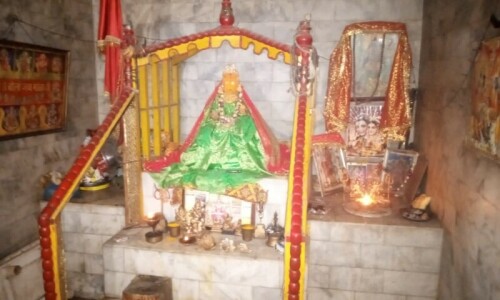
Construction of commercial building begins at site of Khyber temple


KHYBER: Construction of a commercial building has begun at the site of a historical temple in Landi Kotal Bazaar here after the demolition of the Hindu place of worship closed since the country’s independence in 1947.
The development comes as the district administration expresses ignorance about the temple’s demolition.
Located in the centre of the Landi Kotal bazaar, the temple was closed in 1947 after the local Hindu families migrated to India.
It was partially damaged by some clerics and seminarians in 1992 following the demolition of the 16th century Babri Masjid in Ayodhya, India, by Hindu fanatics.
Officials insist land records have no mention of mandir in Landi Kotal Bazaar
Authorities find no “illegality” in the approval of the construction of a commercial building at the temple’s site and insist that there was no mention of a “mandir” at that site in official records.
When asked by Dawn on Thursday evening, workers at the site refused to name the builder(s).
Landi Kotal assistant commissioner Irshad Mohmand claimed the land in the entire Landi Kotal Bazaar was owned by the state, but there was no mention of the Hindu temple in the old land revenue records.
He told Dawn that a no objection certificate was issued to the builder for the renovation and repair of some old shops in front of the temple.
His staff members told Dawn that it was the responsibility of the auqaf department to maintain and preserve historical non-Muslim places of worship, but the department had no office or employees in Khyber tribal districts.
They added that the tehsil municipal authorities granted permission to put up commercial buildings or shops at all commercial and trade centres in tribal districts.
Tehsil municipal officer Shahbaz Khan, who took charge of his office on Friday, told Dawn that the local government was authorised to give the go-ahead for the construction of all commercial structures in the area only after their maps or drawings were approved and the requisite fees were deposited.
He said that approval was granted only after all conditions set by the TMA were fulfilled, which included the site visit by the engineer, the production of a report by patwari, tehsildar and the building inspector, and its thorough examination to see if the applicant possessed original ownership documents.
“We do not have authentic and organised revenue records—a hurdle to the approval of the construction of commercial buildings,” he said.
The TMO also said a notice was served on the owner of the plaza that was under construction.
“Our notice was received by some workers at the construction site, but they refused to disclose the identity of their employer,” he said.
Abdus Samad, the former TMO during whose tenure in the office, the deal for the construction of a commercial building was struck, expressed complete ignorance about any such orders issued by his office.
He, however, said it was the responsibility of the building inspector and engineer of the TMA to first pay a visit to the site and then approve the map or drawing of the new building after learning about the ownership of the site that was duly okayed by the local tehsildar and patwari.
Landi Kotal patwari Jamal Afridi claimed he was not aware of the construction activity at the temple’s site. He added that the revenue records had no mention of a mandir at that site. Tehsildar Taimur Afridi wasn’t available for comments.
Leaders of religious minorities resented the temple’s demolition, saying the act would deal a blow to the cause of interfaith harmony and tolerance towards non-Muslims.
Haroon Sarabdiyal of the Pakistan Hindu Mandir Management Committee insisted that it was the responsibility of the district administration and relevant government departments to ensure the protection and rehabilitation of historical buildings of religious importance to non-Muslims.
He said the archeology and museums department, police, culture department, and local government were bound by the 2016 antiquity law to protect such sites, including places of worship.
“If the government fails to fulfil its obligations towards religious minorities, all their places of worship and other historical buildings will vanish soon,” he said.
Mr Sarabdiyal suggested that the places, which were either not used by minorities or in a dilapidated condition, could be utilised for any social welfare activity to the collective benefit of the local communities.
Published in Dawn, April 6th, 2024