Fear eclipses election campaign in India’s strife-torn Manipur


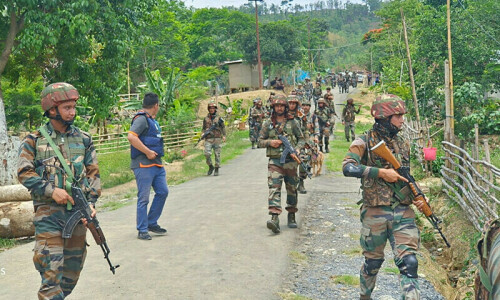
Amid the thunder and fury in India as the world’s most populous nation heads to a general election, the streets of Manipur, a tiny, violence-torn state in the country’s far east, are largely quiet.
Although Manipur and some other regions will be the first to vote in the seven-phase election starting on Friday, campaign meetings are being held behind closed doors because of a fear of violence.
Many residents say there is widespread disappointment over the inability of Prime Minister Narendra Modi’s government to end what critics have called a mixture of anarchy and civil war.
“Is Manipur not a part of India?” asks Francis Keisham, who says he has been living in a refugee camp with his wife and two children after being displaced by the conflict in which at least 220 people have been killed since May. “Are we not Indian citizens? Why are they (the government) ignoring us?”
“I am a refugee in my own land,” said the 42-year-old, adding he had worked for Modi’s Bharatiya Janata Party (BJP) in Manipur for the last eight years, but was now disillusioned with the government and the ruling party.
“If the government truly wanted to solve this, they could have. It would not take them much … the prime minister doesn’t care.”
The state of 3.6 million people has been ravaged by fighting between the majority Meitei and tribal Kuki-Zo people for about a year and continues to be divided into two enclaves: a valley controlled by the Meiteis and the Kuki-dominated hills, separated by a stretch of ‘no man’s land’ monitored by federal paramilitary forces.
Opinion polls predict an easy victory for Modi when the election results are announced on June 4, but Manipur, a state governed by his own BJP, represents a rare security failure for him, contrasting with his carefully cultivated strongman image.
Modi told a regional newspaper last week that there has been a marked improvement in Manipur’s situation because the government “dedicated our best resources and administrative machinery to resolving the conflict”.
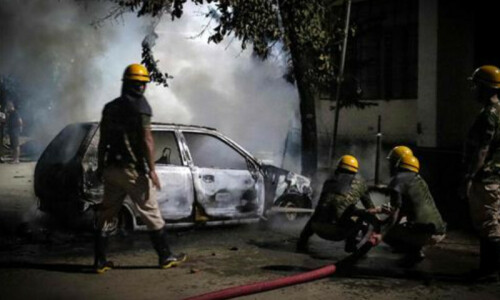
But two Kuki men were killed on Friday in the latest fighting and there is no let-up in the fear pervading the state, residents said.
In its election manifesto, the opposition Congress party has promised to remove the BJP-led state government, “heal the wounds between the communities” and bring “a political and administrative settlement that will be satisfactory to all the people of the state”.
But with its two seats, both of which were won by BJP and its ally in 2019, Manipur has little impact on national politics and the 543-seat parliament. The BJP’s manifesto does not even mention the state.
Manipur has less than 0.5 per cent of India’s population, said Sanjib Baruah, an expert on the region who teaches at the Asian University for Women, in Chittagong, Bangladesh, adding, that it is a “very small state far from the Indian heartland both physically and from the minds of most Indians.”
Still, many people said they will vote for the BJP, Meiteis because they have support from the BJP-led state government and Kukis because they expect the BJP to win power in New Delhi and will be in a position to give them some relief.
‘Air of fear’
Pradeep Jha, the chief electoral officer of Manipur, told Reuters that part of his job was urging people to vote. “Our point here is if you are dissatisfied with the system there is all the more reason to vote, to make your voice heard,” he said.
But for 42-year-old Lalboi Touthang, a Kuki refugee living with his wife and three kids in a relief camp in Churachandpur town for nearly a year, this advice sounded hollow. “We are at war … so how do we just vote like everything is normal?” he asked.
The state and election officials have made efforts to ensure that around 24,500 displaced people can vote on Friday, replacing lost identity cards, verifying names in voter rolls and setting up nearly 100 polling booths for those living in relief camps.
But a second election official, who did not want to be named to discuss the situation, said diktats from a powerful armed Meitei outfit called Arambai Tenggol banning election campaign have added to the complexity.
“There is an air of fear,” he said.
The violence in Manipur first broke out over the potential extension of affirmative action rights available to the Kukis, who make up 16pc of the state’s population, to the dismay of the majority Meiteis, who form 53pc of the people.
The Kukis want the federal government to carve out a separate administration to govern the hills, accusing the state’s BJP Chief Minister Biren Singh of being partial to his Meitei community.
Modi’s government has blamed a refugee influx caused by the 2021 coup in neighbouring Myanmar for the violence in Manipur and announced it will end a decades-old policy allowing visa-free movement of people living along the 1,650-kilometre porous border, which it will fence.
Both decisions have upset the Kukis, who share lineage with Myanmar’s Chin tribe.
“We all know that the centre (New Delhi) is favouring the other community,” said Muan Tombing, general secretary of the Indigenous Tribal Leaders Forum, which represents Kuki interests. “But the prime minister is likely to win another term, so we hold on to the hope that he will listen to us one day.”
Keisham, the Meitei in the refugee camp, however, says he has lost faith in the BJP. When asked whether he would still work for the party, he smiled and said: “BJP who?”