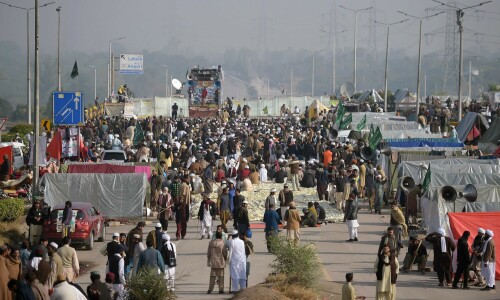
ISLAMABAD: Although the primary objective of setting up the Faizabad commission was to fix responsibly for the failures that led to the Tehreek-i-Labbaik Pakistan’s (TLP) 2017 sit-in spiraling out of control, the commission’s report stops short of placing the blame directly on any individual’s shoulders.
Its most damning finding, however, seems to be against the Shehbaz Sharif-led Punjab government, which it says not only failed to prevent protesters from entering the capital, but even prevailed upon then-prime minister Shahid Khaqan Abbasi to allow them to hold a demonstration at Faizabad, thinking they would disperse afterwards.
“The government of Punjab remained evasive and weak. Had they acted firmly at the beginning, the situation would not have come to such a pass. Allowing them to proceed to Islamabad was not a proper decision,” the report says, adding that then-Punjab law minister Rana Sanaullah remained conspicuous by his refusal to appear before the commission, or answer any of its questions, either in writing or otherwise.
As per its terms of reference, the commission was asked to “inquire into any illegal financial and/or other support provided to TLP for the sit-in; recommend action against those who issued edicts or fatwas during or in relation to the Faizabad sit-in… determine violation, if any, of the law and the liability incurred by any person or public office holders, [and] fix responsibility of any person and/or government officers, including those working with intelligence agencies”.
‘Theoretical’ report blames Punjab govt for allowing protesters into capital; deplores weak command and coordination between security agencies, police
However, a review of the commission’s TORs and background conversations with sources privy to the commission’s workings suggest that its report is silent on many questions it was supposed to answer, being described by one insider as being “theoretical” in its nature.
In addition, the report notes a failure to implement aspects of the National Action Plan (NAP), highlights gaps in the capacity of law enforcement agencies and points out deviations from standard operating procedures (SOPs) that led to a lack of coordination between security agencies and the federal and Punjab governments.
According to the report, the federal government gave Inter-Services Intelligence the go-ahead to negotiate with protesters, and assigned the Rangers DG to lead an operation against them. However, the eventual law enforcement action against TLP demonstrators — which went south, resulting in around seven deaths and over 250 casualties to police and FC personnel — was led by the Islamabad inspector general.
This also raises a legal question: under the laws of the land, armed forces are supposed to act “in aid of civil power”. As such, leading any law enforcement operation falls to the civil administration, which consists of the district magistrate, chief commissioner and police chief.
The report notes that Islamabad police launched an operation to disperse protesters in compliance with the directives of the Islamabad High Court, but “failed due to a lack of coordination between Rawalpindi and Islamabad police”, adding that this also indicated the inability of the Rawalpindi administration and police to block reinforcements to the protesters.
“Weak command and control was observed at the senior level,” the report noted, referring to a lack of coordination between police in Punjab and Islamabad, and observed that multiple forces doing the same job within the territorial jurisdiction nullify the concept of unity of command.
“There must be one force, that is police, to deal with issues of law and order and resources spent on others may be diverted to Islamabad police… Rangers and Frontier Constabulary have been raised for patrolling border areas, therefore, their use in urban areas may be avoided,” it observed.
Published in Dawn, April 18th, 2024