Politics of self-defence


ISRAEL’S April 1 attack on Iran’s diplomatic compound in Damascus — which killed senior Iranian military commanders — was a clear and unprecedented violation of international law. It was an armed attack on both Syria and Iran whose sovereignty and territorial integrity were violated under Article 2(4) of the UN Charter. Diplomatic missions and consular premises in particular are inviolable under customary international law, as well as Article 22 of the Vienna Convention on Diplomatic Relations 1961 and Article 31 of the Vienna Convention on Consular Relations, 1963, both conventions which Israel is party to. Diplomatic missions are considered the sovereign territory of the sending state, and as such, Israel’s armed attack was technically conducted on Iranian soil as much as it was on Syrian territory.
The International Court of Justice has held the inviolability of diplomatic premises in all circumstances, including during international or non-international armed conflict. In the seminal ICJ case ‘Concerning the United States Diplomatic and Consular Staff in Tehran’ (1980), when armed Iranian students stormed and took over the US embassy in Tehran, the ICJ found Iran guilty of violating the law of diplomatic and consular relations and, inter alia, ordered the restoration of the US embassy in Tehran to US possession. More recently, on April 11, Mexico filed a complaint against Ecuador in the ICJ demanding its expulsion from the UN when Ecuadorian police stormed the Mexican embassy without the latter’s consent and arrested former Ecuadorian vice president Jorge Glas, who had been given political asylum by Mexico and was taking refuge in its embassy in Quito.
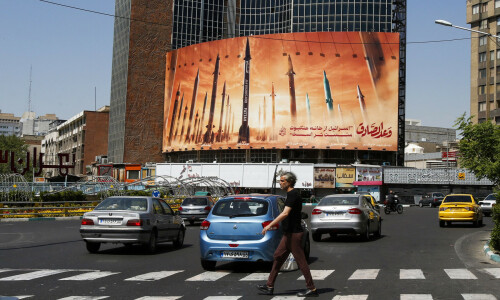
Under the law of armed conflict Iran, not just for the attack on its diplomatic premises but also for what it describes as “repeated military aggressions”, invoked its inherent right of self-defence codified under Article 51 of the UN Charter to strike Israel with over 300 drones and missiles 13 days after the attack. (A suspected Israeli attack on Isfahan has followed) Article 51 states “[n]othing in the present Charter shall impair the inherent right of individual or collective self-defence if an armed attack occurs against a Member of the United Nations, until the UN Security Council [UNSC] has taken measures necessary to maintain international peace and security”.
Under customary law, an act of self-defence must be necessary and proportionate. Its necessity must be “instant, overwhelming, leaving no choice of means, and no moment for deliberation” as outlined by US secretary of state Daniel Webster in the 19th-century Caroline incident. However, the definition of what an instant response is, is based on state practice and can extend beyond days or even a few weeks following the triggering attack. For example, following 9/11, the US formally informed the UN it was invoking the right of self-defence when it attacked Afghanistan on Oct 7, 2001, which was considered a timely response by the UNSC.
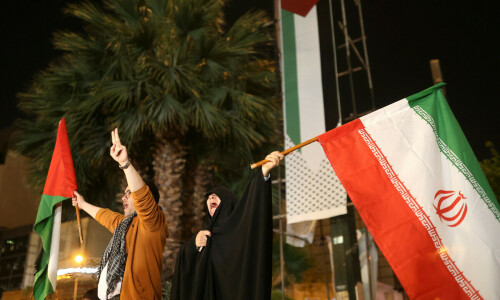
Iran’s retaliatory strikes were an attempt to not appear weak in the eyes of the Iranian polity.
Virtually all projectiles fired by Iran towards Israel were intercepted by Israel, the US, UK, France, and Jordan, resulting in no fatalities and minimal damage to Israeli military installations. For many, the irony of the West’s failure to intercept a single Israeli missile or drone targeted at Palestine — many of them provided by the West itself — in the face of its demonstrated defensive capabilities was palpable; despite Western rhetoric on championing human rights and international law, it continues to proffer moral and materiel support to Israel in its pogrom against the Palestinians.
Iran claims it informed the US prior to initiating its attack, stating that it would be conducted in a manner to avoid provoking a response from Israel. Following the attack, Iran stated that its armed response was concluded and that it did not seek any further escalation, indicating that the attack was largely symbolic and its objectives were primarily political.
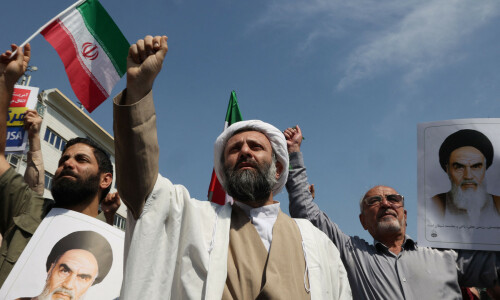
It appears that Iran is catering to its domestic audience; given the internal challenges the regime has been facing, including civil unrest attributed to economic meltdowns and political repression, one can argue that Iran’s retaliatory strikes were an attempt to not appear weak in the eyes of the Iranian polity.
Iran is also focused on regional dominance, with its influence established in Syria, Yemen, Lebanon, and Iraq. Given the inability of the powerful yet fragile autocratic regimes of Saudi Arabia, Egypt, Jordan, and the UAE to meaningfully intercede in the Palestinian genocide or take legal action against Israel, as has been commendably done by South Africa and Ireland against Israel for genocide, and Nicaragua against Germany for complicity in Israel’s genocide at the ICJ, Iran sees an opportunity to exert influence over the populations of these competing Middle Eastern countries, further consolidating its dominance. One silver lining emerging from the affair, however, is that progressive European states such as Spain and Ireland, have since become increasingly active in advocating for the formal recognition of Palestine as a high contracting party at the UN and public support in the US, particularly among young Americans, is shifting towards the Palestinians.
The biggest challenge facing the contemporary ‘rules-based world order’, however, is the abject failure of the UNSC to maintain international peace and security, its primary obligation and responsibility under the UN Charter. To date, no binding Security Council resolution has been issued under Chapter 7 in relation to Israel’s actions towards Palestine, which would come with the sanctions and enforcement powers necessary to prevent Israel from its genocidal campaign against the Palestinians. Should use of force by Israel or Iran be deliberated in the near future at the UNSC, the US, UK, and France would likely continue to veto any Chapter 7 resolutions against Israel as they have done in the past, while Russia and China can be expected to veto similar resolutions against Iran, especially after Israel’s attack on the Iranian consulate in Damascus or Iran’s response.
With the proliferation of sophisticated weaponry, including nuclear weapons in Israeli and arguably Iranian hands now, proxy wars in the region are escalating into direct military confrontations between regional states. This trend represents a disquieting shift in the maintenance of global peace and security, and particularly for the people of Palestine, who have a vested right to sovereignty and self-determination.
The writer is former legal adviser to Pakistan’s foreign ministry, and faculty, Lums Law School.
Published in Dawn, April 20th, 2024