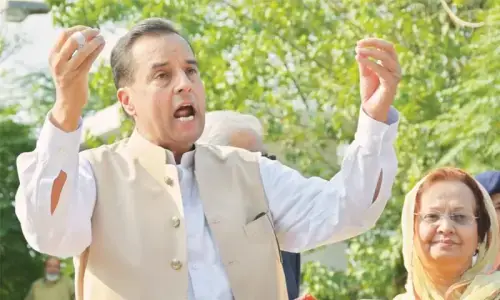
LAHORE: The panelists at a session titled ‘Radicalizing mainstream politics’ at the 5th Asma Jahangir Conference on Sunday shed light on the pressing issues of politics, religion, and minority rights in Pakistan.
Speaking on the occasion, human rights activist Prof Dr Arfana Mallah criticised the Jamaat-e-Islami (JI) for, what she called, the party’s historical stance against Pakistan and its role in supporting the first martial law in the country. She was of the view that the JI’s narrative had been adopted in the Constitution, leading to the inclusion of anti-women laws in it.
Mallah also highlighted that Pakistan stands alone in its support for the Muslim Ummah, with other Muslim countries showing little concern.
Lala Robin, Chairman of the National Minorities Alliance of Pakistan, expressed the sense of loss felt by the minorities living in the country after the death of Asma Jahangir. He recalled how members of minority communities would approach Jahangir when facing discrimination.
Robin lamented that minorities in Pakistan are still not mainstreamed.
Pastor Ghazala echoed these sentiments, stating that she had not seen any equality for religious minorities in the last 60 years in Pakistan. Despite numerous laws and international agreements, she claimed that none have been implemented in their true spirit. Ghazala called for the separation of state and politics from religion.
Peter Jacob, Executive Director of the Centre for Social Justice, proposed the establishment of an inquiry commission on minority-related cases. He suggested that a national commission should be established through legislation in the parliament and run on a secular basis, not as a religious department.
Writer Aamir Rana pointed out the state’s failure to provide equal rights to its two percent minorities, calling it a challenge for the state’s existence.
Reem Alsaleem, UN Special Rapporteur, discussed gender bias, stating that it is motivated by gender discriminatory practices. These biases can magnify based on a woman’s religious and ethnic status. Alsaleem criticised the way self-identification legislation has been put forward, arguing that it has ignored the concerns of women’s groups.
Published in Dawn, April 29th, 2024