THE tripartite Iran-Pakistan-India Pipeline project (IPI) should have had a normal maturity, had it not suffered from a genetic defect. Physicians term it a complex disorder, which has mutations in two or more genes inherited from parents.
The IPI project could not have had a simpler geopolitical justification. Iran has proven natural gas reserves of about 1,200 trillion cubic feet, enough to last 162 years. Its needy neighbour Pakistan has natural gas reserves of only 18 tcf, enough for the next 12-15 years. India’s offshore reserves of natural gas are to its east (40.6 per cent) and to its west (23.7pc). It made sense for India to look westwards, even if it involved Pakistan as an undependable intermediary.
Economics cried out for such a project. International politics, however, proved the malevolent spirit determined to curse its future.
Initially, in 1995, Iran, Pakistan and India signed an agreement which made Iran responsible for 1,180 kilometres of the IPI pipeline, Pakistan 705 km and India 850 km. The pricing of the product had been agreed at $4.937 per MBTU, linked to an average Japanese Crude Cocktail price.
Pakistan is trapped between two options.
The logical solution to ensure continuity of supply was for all three countries to have jointly owned the IPI project, through one corporate entity registered outside the three countries, with legal safeguards in place to prevent any of its members from reneging on their obligations.
In 2008, however, India signed two major agreements with the US on nuclear energy and military cooperation. As a consequence, the following year, India withdrew from the IPI project.
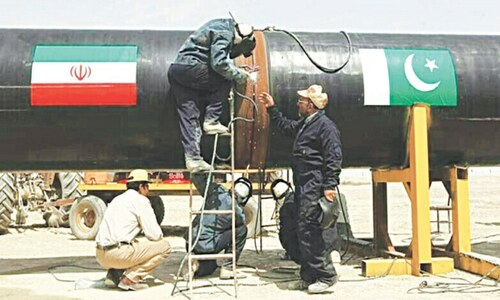
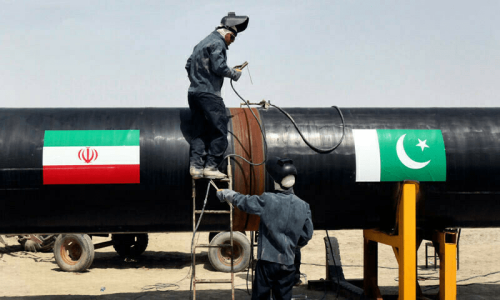
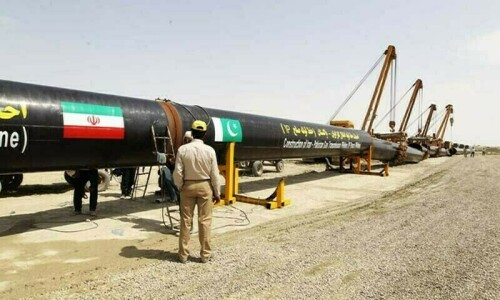
Since then, the Iranians undeterred have completed their 1,172 km of the truncated pipeline from the South Pars gas field to the Iran-Pakistan border. Pakistan has yet to begin its section. The cost in 2012 was estimated at $1.8 billion. Its new cost is open to the heavens. A few years later, Pakistan pleaded a weak force majeure when it formally informed Iran that, as long as Tehran is subject to US sanctions, it could not start work on its end of the pipeline.
This year, Pakistan’s interim government approved the construction of a token 80 km to Gwadar — a lame attempt to forestall Iran’s threat to invoke up to $18bn of penalties for the delay. Iran has granted Pakistan until September 2024 to complete the remaining 625 km.
At the conclusion of the recent visit by the Iranian president Dr E. Raisi, a joint statement by both governments “reiterated the importance of cooperation in the energy domain, including trade in electricity, power transmission lines and [almost as an afterthought] the IP Gas Pipeline”.
Pakistan, meanwhile, is searching for ways to wriggle under the forbidding door of US sanctions. At best, it can hope for a US waiver, which is rare but not impossible. The Pakistan Foreign Office maintains that Pakistan does not need a waiver. The petroleum minister contradicted this by admitting that it is “considering formally contacting the US government to request a waiver of sanctions”.
The US has countered Pakistan’s Janus stance through Donald Lu, the US assistant secretary of state named in the Imran Khan cipher case. He has testified that Pakistan has not yet applied for a waiver. He added that, even if granted, Pakistan would find it difficult to secure funding from international donors.
Pakistan is trapped between two options: crippling sanctions or prohibitive penalties, between an American devil and the deep Caspian Sea. What was once touted as a pipeline of peace has been re-engineered into an instrument of war.
The Pakistani public stands confused by the government’s unconscionable reticence. No meaningful information is available in the public domain about the present status of the IP project — important, because it promised to provide enough gas to generate up to 5,000 MW (one-fifth of our present thermal capacity).
What will be the final cost of the IP project, and the sources of its funding? (Iran initially had offered a loan of $500 million.) Also opaque are the IP’s achievable completion date, the price at which Iranian gas is to be supplied, safeguards and penalties for non-supply and non-off-take. A gas sales and purchase agreement was signed between Iran and Pakistan in June 2009, and an operations agreement in March 2010. Are they still operative? Factor in the downstream losses in defective transmission and dishonest distribution. In FY2022-23, 10 Discos averaged losses of 16.38pc.
In the mid-1970s, Iranian PM Amir-Abbas Hoveyda visited Islamabad. Passing some flowering roses in the Secretariat garden, his Pakistani hosts invited him to admire them. He gave them a glance, and dismissed them with the aside: “Yes, it is all a matter of priorities.” Had the President Raisi come to Islamabad last week to task us to determine our priorities?
The writer is an author.
Published in Dawn, May 2nd, 2024