Climate catastrophes of the past


IF words could cool people down, writers would be very busy these days. As the heat index rises to previously unheard of levels, it is tempting as an author to write columns that evoke the very opposite of the fiery hot reality that most Pakistanis are enduring these days.
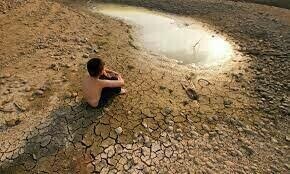
Alas! Words fail when it comes to making the discomfort of such unbearable heat any more tolerable. The sweat, the dehydration and the danger of heatstroke are real threats that can kill a human being and cannot be imagined away. Even more troubling is the fact that the prognosis for the future threatens a continuation of, even an increase in, the hellish heat of the present.
Another strategy of diversion from the cataclysms of the present is to place them in a historical perspective. The wider the lens and the further back one looks, the more one realises that nearly every catastrophe that confronts human beings in the present moment is one that people in the past have already had to endure. One of the highest temperature readings these past days was in the ancient site of Mohenjodaro, where the temperature reached 52 degrees Celsius. The settlement, which is said to date back to 2500 BCE, may be among the places that tell us most about climate catastrophes of the past.
Analyses of Mohenjodaro’s layers of sand and soil reveal that the city was flooded multiple times during its period of inhabitancy. These floods are believed to have caused destruction on the scale of the recent ones in Sindh. Scholars have long argued over what caused the Indus Valley Civilisation, of which Mohenjodaro was a central settlement, to simply disappear. Archaeological findings suggest that this city, which was a highly developed metropolis complete with a proper sanitation system and well-maintained roads, was abandoned and left to crumble.
Climate change may not have been the definitive reason why the civilisation fell or why Mohenjodaro was abandoned, but it is known that the area was suffering the consequences of tectonic shifts. Evidence of this can be seen in prehistoric ‘beaches’ in Pakistan. These beaches, which have evidence of marine life in a place that is far inland, reveal that during prehistoric times, many places were closer to the ocean than they are today.
Tectonic shifts in Sindh and Balochistan possibly caused the seas to recede and the coastline to be altered. It may well have been that it was these shifts that caused migration and demographic shifts, which meant that even advanced cities like Mohenjodaro could not tolerate the onslaught of repetitive climate catastrophe.
It is plausible that a combination of foreign invasions and natural catastrophes wiped out the Indus Valley Civilisation.
The climate shifts taking place in Pakistan, one of the world’s most vulnerable countries threatened by the effects of climate change, are palpable and terrifying. Temperatures like 52 degrees Celsius were unimaginable even as recently as a couple of decades ago. The flash floods and rains that now ravage cities were rare.
Even as they wreak utter havoc and destruction on Pakistani cities, there are few lessons learned, and inhabitants are restricted to self-help measures as they deal with the consequences of widespread corruption, apathy and disinterest in preparing for the consequences of climate change. This year, after people have borne the unbearable heat, the rain and the floods are predicted to come again; once more, our cities will face a wave of destruction brought on by urban flooding.
A recent report released by the German development agency GIZ shows just how terrible things are going to get. By 2080, the temperatures in the country will have risen by over 4°C. This means that places that are seeing temperatures in the upper 40s will become uninhabitable as human beings cannot tolerate such heat without severely suffering its effects.
Sea levels are expected to rise by 40 centimetres, which means that large swathes of the coastal area, including where construction has been carried out on reclaimed land, will be submerged. In prehistoric times, it was the rising of tectonic plates that caused the sea to recede; now the rising of the seas may reclaim the land that emerged thousands of years ago.
Prehistoric-era climate change led to drought conditions. The unpredictability of the water supply, something modern-day city dwellers will identify with, meant that infrastructure and agriculture both suffered drastically. It is plausible then that a combination of foreign invasions and natural catastrophes wiped out the Indus Valley Civilisation thousands of years ago.
The gargantuan climate-related challenges, which drought-struck and heat-harried cities along the Indus valley all the way to Karachi face today, create the feeling of a cataclysmic ending. It is impossible not to wonder whether the inhabitants of civilisations that fell in the past were conscious of the fact that their way of life, the place they called home, their basis of existence, could be wiped out in the manner that it was.
My guess is that they were not. People by nature are optimists, who have great faith in the ultimate victory of survival. People in Pakistan are enduring the scalding heat, trying to find shade or water or respite and, like all optimistic humans, imagining better times ahead. Unfortunately, the data shows that respite is unlikely and that conditions are already such that large swathes of areas occupied today will either disappear into the sea or be subjected to very high temperatures and extreme drought — in a nutshell, no one will be able to live here.
The entire world is living in momentous times, when deep civilisational changes are happening right before our eyes. Glaciers are melting, rivers are flooding, seas are rising, and heat and havoc are the only certainty. These momentous times are not comfortable, but it seems there is no escape from them.
The writer is an attorney teaching constitutional law and political philosophy.
Published in Dawn, June 5th, 2024