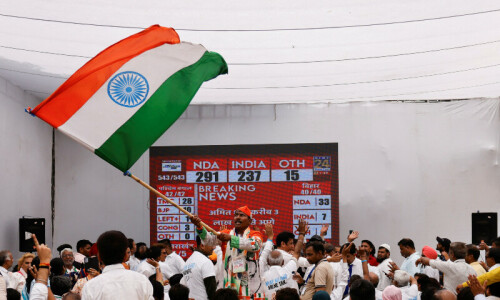
IT is likely to be a bittersweet victory for the BJP and its ideological cohorts in the Sangh Parivar as India finishes counting the votes from its massive electoral exercise.
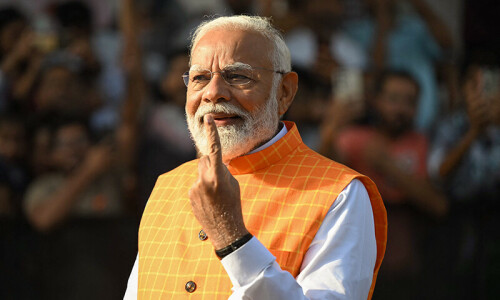
While Narendra Modi is poised to form his third consecutive government, electoral trends at the time of writing indicate that the BJP and its allies will be nowhere near translating their boastful claims of winning 400 seats in the Lok Sabha into reality.
The projections predict a simple, albeit thin, majority for the BJP-led National Democratic Alliance. The INDIA grouping, led by Congress, has made surprising gains, with a likely tally of around 200 seats. It should be remembered that in 2019, Congress was walloped; in fact, India’s grand old party has spent the last decade in the political wilderness, as the BJP played up the Hindutva card, tearing apart the political structure built by Nehru and Gandhi. But the latest results indicate that things may be changing.
For the BJP, Muslim-baiting and communal rhetoric appear to have backfired, even in its political heartland or ‘Hindi belt’. Instead of praising the glory of a new Hindu rashtra, Indian voters were more concerned about pressing issues, such as jobs and the cost of living.
The Ram Mandir, inaugurated by Mr Modi in January, may have been a grand spectacle, but tens of millions of voters were clearly not swayed by this dangerous mixing of politics, mythology and communalism. Mr Modi’s hounding of India’s Muslims — the anti-Muslim rhetoric was particularly pronounced during the poll campaign — has failed to translate into electoral dividends for the Sangh this time around.
It is hoped that the sobering election results lead to a dialling down of the inflammatory rhetoric against Muslims, and that the toxic communalism that has been promoted in India for political gains over the last decade is discarded.
Coming to relations with Pakistan, from 2019 onwards, bilateral ties have been at their lowest in decades under Mr Modi’s watch. India’s unilateral decision to annex held Kashmir has perhaps been the biggest obstacle standing in the way of better ties. Moreover, Mr Modi and his ministers have also used provocative language aimed at Pakistan, including during the election campaign, which has hardly served the cause of peace.
Once the dust settles in Delhi and the BJP forms the next government, we hope that Narendra Modi reviews his foreign policy. India should reach out to Pakistan, and the state should respond positively to any Indian overtures. Naturally, rebuilding trust will take time, but long-term peace in South Asia is impossible without better Pakistan-India ties.
India cannot skirt around the Kashmir question; both sides should at least start talking, even if they agree to disagree. Let India’s incoming government start afresh with Pakistan.
Published in Dawn, June 5th, 2024