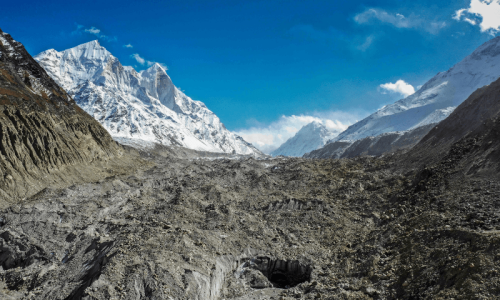
Low snow on the Himalayas threatens water security: study


Millions of people dependent on Himalayan snowmelt for water face a “very serious” risk of shortages this year after one of the lowest rates of snowfall, scientists warned on Monday.
Snowmelt is the source of about a quarter of the total water flow of 12 major river basins that originate high in the region, a report said.
“This is a wake-up call for researchers, policymakers, and downstream communities,” said report author Sher Muhammad, from the Nepal-based International Centre for Integrated Mountain Development (ICIMOD).
“Lower accumulation of snow and fluctuating levels of snow pose a very serious increased risk of water shortages, particularly this year.”
Snow and ice on the Himalayas are a crucial water source for around 240 million people in the mountainous regions, as well as for another 1.65 billion people in the river valleys below, according to ICIMOD.
While snow levels fluctuate each year, scientists say climate change is driving erratic rainfall and shifting weather patterns.
The report measured “snow persistence” — the time snow remains on the ground — with levels dropping almost a fifth below normal this year across the wider Hindu Kush and Himalaya region.
“This year’s snow persistence (18.5 per cent below normal) is the second-lowest in the past 22 years, narrowly trailing the record low of 19pc set in 2018,” Muhammad told AFP.
As well as Nepal, the inter-governmental ICIMOD organisation includes member countries Afghanistan, Bangladesh, Bhutan, China, India, Myanmar and Pakistan.
The report warned that ICIMOD “observations and projections indicate significant changes in the timing and intensity of stream flows”, with snow a key part.
“Snow plays a particularly important role in ensuring seasonal water availability,” it added.
The organisation has been monitoring snow in the region for over two decades, noting that 2024 marked a “significant anomaly”.
The Ganges river basin, which flows through India, had the “lowest snow persistence” that ICIMOD has recorded, 17pc below average, worse than the 15pc in 2018.
The Helmand River basin in Afghanistan recorded its second-lowest snow persistence levels, 32pc below normal.
The Indus River basin was down 23pc below normal levels, while the Brahmaputra River basin, which ends in Bangladesh, had snow persistence “notably below normal” at 15pc.
Miriam Jackson, the senior cryosphere specialist at ICIMOD, urged authorities to “take proactive measures to address possible drought situations”.