Senate panel terms budget against national interests


ISLAMABAD: The Senate Standing Committee on Finance has expressed dissatisfaction with tax measures announced in the budget 2024-25, lamenting that they appeared more aligned with the International Monetary Fund (IMF) priorities than national interests.
The committee, led by Chairman Senator Saleem Mandiwalla, concluded its discussions on the Finance Bill 2024 on Saturday. The committee is set to deliver its recommendations on Monday and promptly send them to the Senate on the same day.
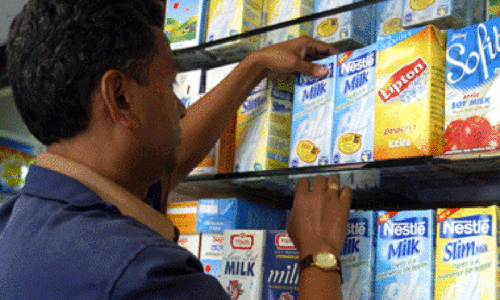
The committee also expressed concerns regarding the unequal distribution of the tax burden, particularly among those less fortunate and vulnerable. The imposition of taxes on infant milk is highly controversial, as it burdens newborns excessively.
Officials from the Federal Board of Revenue (FBR) revealed that tax exemptions were removed from 337 items, which fell short of the IMF’s demand for 749 items. In addition, the official said that the IMF wants FBR to generate Rs40bn from milk products and Rs7bn from stationery items.
According to tax officials, the IMF is pushing to remove tax exemptions worth nearly Rs107bn.
Tax on graves?
Senator Farooq H. Naik stated that the budget is being implemented exactly as was dictated by the IMF, with every recommendation being accepted. Senator Anusha Rehman raises an important question about the tax being imposed on graves.
Mr Naik said there may come a time when burial expenses will even be subject to taxation. He mentioned that the IMF is unaware of any such tax on graves. In addition, he stated that all items are being subjected to taxation due to the influence exerted by the IMF.
According to Ms Anusha, tax measures, particularly on telephone sets, will place a heavy burden on the less fortunate. She believes implementing an 18pc sales tax on mobile sets priced below $200 will increase their prices.
These measures will significantly affect individuals from low-income backgrounds and mobile phone sets are not considered luxury items. The committee has decided against implementing an 18pc sales tax on phones priced up to $200.
Mr Mandiwalla said the government’s tax initiatives would fuel inflation by 10pc in the coming fiscal year. He stated that the committee had rejected the proposal to levy a tax on various commodities.
He stated that the government typically accepts half of the committee’s recommendations.
At the outset, the committee strongly disapproved of proposed taxes on stationery items such as coloured pencils, pencils, and geometry sets. They argued that the budget 2024-25 would be overly burdened with taxes, citing the slogan of an 18pc GST on every item.
The senators believe these taxes would further increase the cost of living and negatively impact public morale.
Costly healthcare
Ms Anusha highlighted concerns over the taxation of medical equipment, emphasising the impact on healthcare costs, including endoscopy, oncology, urology, gynaecology, and disposable items. The committee also questioned the basis for granting tax exemptions to certain charitable hospitals, with the FBR clarifying that the Pakistan Centre for Philanthropy (PCP) holds the authority to grant such exemptions.
The committee further recommended subjecting donated goods to hospitals operated by non-profit institutions to similar customs duty conditions as those applying to goods with zero-rated customs duty.
Senator Anusha Rahman advocated against proposed tax structures for the telecom sector, particularly concerning cellular and satellite phones, suggesting differentiated tax rates based on import or supply values.
Concluding a rigorous nine-day session on deliberations over the Money Bill 2024, the committee issued recommendations to benefit the general public.
Recommendations
Key recommendations included mandating credit/debit card transactions for purchases exceeding Rs35,000 to promote economic documentation, imposing uniform sales tax rates on solar industry components, withdrawing taxes on eight specified stationery items under the Finance Bill 2024 and requiring price labels on all consumer goods for informed purchasing decisions.
Additionally, recommendations were made to identify organisations exploiting tax exemptions under the guise of charitable status, provide additional allowances equal to 100pc of basic pay for disabled individuals — comprising less than 2pc of the workforce — and distinguish remote workers from freelancers for tax purposes.
The committee also proposed exempting corporate debit card transactions from an additional 5pc tax to prevent double taxation and encourage foreign exchange earnings through Exporters’ Special Foreign Currency Accounts.
Senator Zeeshan Khanzada proposed reducing the sales tax rate on local supplies in erstwhile Fata and Pata to 16pc instead of the standard 18pc, and reducing the tax on imported supplies in these regions to 3pc until June 30, 2025, and 6pc from July 1, 2025, to June 30, 2026.
Published in Dawn, June 23rd, 2024