AS the state continues to explain to the nation what exactly the Azm-i-Istehkam campaign will entail, particularly in the realm of counterterrorism measures, there is also a need to discuss steps to counter violent extremism in the country.
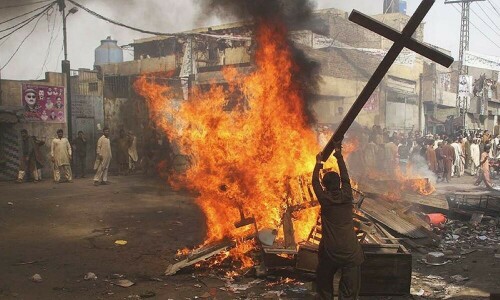
While the military and civil law-enforcement agencies battle militants in the field, a similar campaign should be waged to deradicalise society, as both terrorism and extremism are joined at the hip, and feed off each other. Just over the past few months, we have witnessed lynchings based on doubtful allegations of blasphemy, as well as the persecution of minority communities for practising their faith even within the privacy of their homes.
Thus, while the state takes on what it calls the ‘remnants’ of terrorist outfits, it should not ignore the extremism threat. There may be some realisation of this at the top, as a recent statement from the PM Office, while discussing Azm-i-Istehkam, specifically mentions the need to implement the revised National Action Plan.
Indeed, a blueprint for the deradicalisation of society exists in the shape of the updated NAP. But until NAP’s goals are implemented to the letter, deradicalisation will simply remain a theory, as extremists continue to further their toxic narratives in society. Point number three of the updated NAP mentions “taking effective measures against religious/ sectarian persecution & terrorism”.
As noted, there has been no shortage of incidents of religious and sectarian persecution in Pakistan. The question is: do those who control the levers of state intend to confront the extremist elements that are fanning the flames of hatred in society? Will those who encourage lynch mobs and the persecution of religious minorities be brought to justice?
Unless these bold steps are taken, it is difficult to see Azm-i-Istehkam succeed, and a few years down the line we may witness the launch of a new CT operation.
The key to successfully implementing a CT plan, along with kinetic measures, lies in a practical scheme to counter violent extremism. NAP contains most of these elements, and experts in the field can be consulted to fine-tune the plan. But perhaps the single biggest step that needs to be taken to counter extremism is to bring to heel the groups that are promoting murderous vigilantism in society.
Moreover, some political parties have said 70 ‘banned’ organisations have resurfaced with new names. While there could be a difference of opinion over the actual figure, there is little argument with the fact that ‘banned’ groups are back in business not long after their supposed proscription.
This cat-and-mouse game has been continuing since the Musharraf era. Proscription of violent groups must mean that they are unable to access funds or organise at any level. Anything less would be inadequate.
Published in Dawn, June 26th, 2024