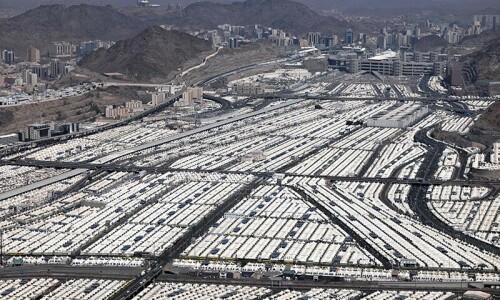
LONDON: The heatwave in Saudi Arabia blamed for the deaths of 1,300 people on the Haj pilgrimage this month was made worse by climate change, a team of European scientists said on Friday.
Temperatures along the route from June 16 to 18 reached 47C at times and exceeded 51.8C at Makkah’s Great Mosque.
The heat would have been approximately 2.5C (4.5 Fahrenheit) cooler without the influence of human-caused climate change, according to a weather attribution analysis by ClimaMeter, which conducts rapid assessments of the role of climate change in particular weather events.
The scientists used satellite observations from the last four decades to compare weather patterns from 1979 to 2001 and 2001 to 2023.
Fossil fuel burning blamed for extreme temperatures
Although dangerous temperatures have long been recorded in the desert region, they said natural variability did not explain the extent of this month’s heatwave and that climate change had made it more intense. The assessment also found that similar past events in Saudi Arabia occurred in May and July, but now June experiences more severe heatwaves.
“The deadly heat during this year’s Haj is directly linked to fossil fuel burning and has affected the most vulnerable pilgrims,” said Davide Faranda, a scientist at France’s National Centre for Scientific Research who worked on the ClimaMeter analysis.
Climate change has made heatwaves hotter, more frequent and longer lasting. Previous findings by scientists with the World Weather Attribution group suggest that, on average globally, a heatwave is 1.2C hotter than in pre-industrial times.
Medical authorities generally do not attribute deaths to heat, but rather to the heat-related coronary or cardiac illnesses exacerbated by high temperatures. Still, experts said it is likely that extreme heat played a role in many of the 1,300 Haj deaths.
“The idea that an activity so central to the Muslim faith is now so dangerous needs to be a wake-up call,” said Mohamed Adow, director of nonprofit Power Shift Africa. “Saudi Arabia is one of the biggest oil producing nations in the world and they often act to frustrate and delay climate action. They need to realise their actions have consequences.”
Saudi Arabia is the world’s second-largest oil producer, after the United States, and state oil firm Saudi Aramco is the world’s largest corporate greenhouse gas-emitter. It is responsible for more than 4pc of the world’s historical carbon emissions, according to a database of emissions from carbon majors.
Published in Dawn, June 29th, 2024