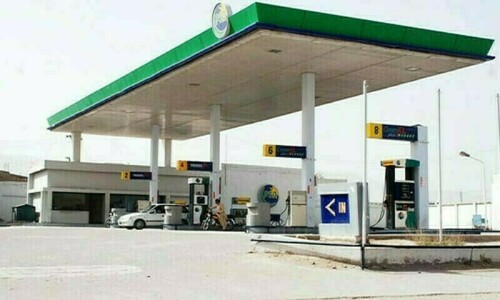
• Dealers from Karachi say pumps nationwide to shut from 6am today
• One PPDA group accuses Karachi chapter of prioritising OMCs’ interests
• Govt hints at higher commission, passing on tax impact to consumers
ISLAMABAD: The official machinery appeared to have formalised a split among the protesting petroleum dealers, inducing some of them with hints for higher commission on sales of petroleum products to pass on the impact of turnover tax to consumers.
Meanwhile, oil marketing companies (OMCs) have called for a 60 per cent increase in their profit margins.
Abdul Sami Khan, chairman of the Pakistan Petroleum Dealers Association (PPDA), told Dawn from Karachi that pumps would be closed from 6am on Friday throughout the country although some people who he could not name were “resorting to intimidation”.
On the other hand, the petroleum division kept on asking all the six chief secretaries of the four provinces, Azad Jammu and Kashmir, and Gilgit-Baltistan to allow “operation of oil tankers movement” during the day on July 5 to ensure uninterrupted supply of petroleum products to the open retail outlets “in case the strike becomes effective”. In normal circumstances, the oil tanker movement is not allowed during daytime.
It also asked the provincial governments to “endeavour/facilitate the opening of maximum petrol pumps and nominate focal persons for close coordination”.
The oil marketing companies have already been directed to keep their outlets operational during the strike and remain in contact with the Ministry of Energy’s monitoring cell.
A joint statement by Ogra and the petroleum division said that there was sufficient availability of petroleum products in the country, and all OMCs had been advised to ensure adequate supplies at petrol pumps.
In Islamabad, some officials not belonging to the petroleum division, Federal Board of Revenue, finance ministry or Ogra were seen interacting with dealers to convince them to call off the strike.
Government representatives reportedly indicated a possible increase in dealer commissions to compensate for the 0.5pc turnover tax, suggesting an increase from the current commission of Rs8.64 per litre to at least Rs11.20.
A dealer said that a revision in commission and OMCs’ margin had already become due in the new fiscal year and the government was just trying to divide them.
Sources said the government side did not make any commitment at this stage to avoid similar pressure tactics from other sectors facing the brunt of the additional tax burden, but the facilitators promised them a positive outcome in due course.
The dealers promised to keep their filling stations in Rawalpindi, Islamabad and Lahore fully operational on Friday.
OMCs seek higher margin
Meanwhile, the oil marketing companies have formally demanded an increase in their profit margin on petrol and diesel sales to Rs12.65 per litre from Rs7.87 at present, up by 60pc.
On behalf of OMCs, the Oil Companies Advisory Council (OCAC) has recommended that this increase was necessitated by “financing costs of maintaining a 20-day stock cover, turnover tax, handling losses, demurrage, financing cost of unadjusted sales tax and operating expenses incurred by OMCs”.
At present, there are about 14,000 retail stations in the country, including about 4,000 owned or operated directly by the major oil marketing companies.
A dealers’ group from Lahore and Rawalpindi, identifying as the Reformers Group of the PPDA, announced they would not participate in the July 5 strike. In a statement, they said their group would prefer detailed negotiations with the authorities before opting for “extreme options” like an indefinite strike.
“After giving the strike call, negotiations are useless, so petrol pumps will be kept open all over the country on July 5, as the country’s economy cannot be jammed at this critical juncture,” it said.
Hasan Shah, the group’s spokesperson, said a delegation led by PPDA Rawalpindi leader Numan Ali Butt met Minister of State for Finance Ali Pervez Malik and informed him that petroleum dealers might be charged either a fixed tax or regular tax. A business couldn’t be taxed both ways, and if it were to do so, it would be illegal, and the petrol pumps would be shut down, he explained.
The minister assured them that the FBR chairman would address the matter, the group said in a statement.
Mr Shah said that detailed discussions were ongoing. “If there is no success, then any decision will be taken after consultation with the organisation of each district of the country,” he said.
“We reject the strike call by some dealers in Karachi because they are working for the interests of oil marketing companies and not concerned about their own community.”
Published in Dawn, July 5th, 2024