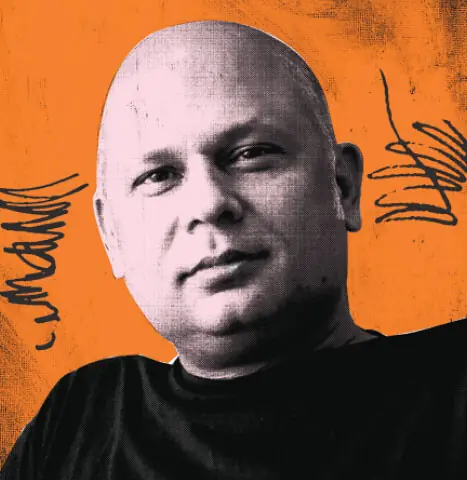
Jab Moarikh Ke Haath Bandhay Thay — Tarikh-i-Pakistan Ke Gumshuda Goshay
By Dr Farooq Adil
Qalam Foundation
ISBN: 9-789697-461059
288pp.
You cannot miss the words ‘Gumshuda Goshay’ [Lost Pages] on the cover of Dr Farooq Adil’s Jab Moarikh Ke Haath Bandhay Thay [When The Historian’s Hands Were Tied]. Coupled with the veteran author’s expertise in journalism and column writing, the book promises to unveil significant historical insights that are not to be missed.
It was only last year when Dr Adil’s book Hum Ne Jo Bhula Dia [What We Forgot] hit the market and turned out to be a bestseller. This, his second book, is also a compilation of articles he mostly wrote for the BBC’s Urdu website, suggesting a dive into the hidden or overlooked aspects of history.
The 288-page book is likely to challenge conventional narratives and present perspectives that differ from those taught in the Mutaalia-i-Pakistan or Pakistan Study books. For those open to exploring different viewpoints and seeking a deeper understanding of historical events, this book could offer valuable and enlightening insights.
Dr Adil delves deep into the pivotal moments and often misunderstood or lesser-known events in the history of India and Pakistan. These include instances where both nations opted for peaceful resolutions (such as returning huge areas of land, rectifying the Radcliffe Award), of conflicts involving figures like the Faqir of Ipi against the British Raj, and the ‘almost’ appointment of one’s citizen as the other’s prime minister.
A second book compiling articles mostly written for BBC Urdu challenges conventional narratives and presents perspectives that differ from those taught in Pakistan Study books
The last of the stories mentions Iskandar Mirza, the first president of Pakistan. He had the idea of nominating the Nawab of Bhopal as the next prime minister after dismissing Feroz Khan Noon, the then prime minister. This move reflects the political manoeuvres and instability in Pakistan during that period. It not only highlights the quirks and unexpected twists in political history but also reflects on the absurdities that can arise in the Subcontinent’s political landscape. The book also traces when and how socialism was linked with non-believers and the complexities surrounding Pakistan’s evolution into an ‘Islamic state’.
The fall of self-proclaimed Field Marshal Ayub Khan was indeed a turning point in Pakistan’s history, and Dr Adil’s use of a flashback narrative to recount these events adds a vivid and cinematic quality to the story. Ayub Khan’s era (1958 to 1969) saw significant development but also growing political unrest. The narrative — starting at Gen Ayub’s funeral and then recounting his tenure and eventual downfall — provides a poignant contrast between his once-powerful position and his ultimate demise.
The story of the Nawab of Kalabagh, Malik Amir Mohammad Khan, is equally dramatic. Known for his strong personality and significant influence during Ayub Khan’s era, the nawab’s murder by his son adds a layer of personal tragedy and political intrigue.
Another interesting fact elaborated in the book is the framing of the Agartala Conspiracy and how Shaikh Mujeeb-ur-Rehman, another powerful figure of the era, was implicated in the controversy, despite being in jail. The comedy of errors that followed led to the horrific incidents that led to the birth of Bangladesh.
The news of the 1971 surrender by the Pakistan Army is indeed one of the most heart-rending chapters in Pakistan’s history. Incorporating first-hand accounts from journalists who experienced the events, brings a personal and poignant perspective to the historical narrative. These journalists, young at the time, witnessed the unfolding of a national tragedy that left a lasting impact on their lives and careers.
A time jump to the 1980s provides a comprehensive view of Pakistan’s evolving political narrative. The rise of Nawaz Sharif and his intricate relationship with the influential Chaudhry family is a significant part of this period. It’s an open secret that Nawaz Sharif rose to prominence with the support of Gen Ziaul Haq, but how did the Chaudhries — particularly Chaudhry Shujaat Hussain and Chaudhry Pervaiz Elahi — became the rivals of Sharifs, is well-explained in the book.
For those open to exploring different viewpoints and seeking a deeper understanding of historical events, this book could offer valuable and enlightening insights.
A comparison between the Quaid-i-Azam Mohammad Ali Jinnah, Zulfikar Ali Bhutto and Nawaz Sharif in Dr Adil’s book is intriguing, especially given their shared astrological sign of Capricorn. This connection provides a unique lens through which to examine their leadership styles and political journeys. Dr Adil’s comparison likely draws attention to how these traits manifested in their policies and decisions, and the impact they had on Pakistan’s history.
The last few chapters cover the ‘legacy’ of Imran Khan and his misadventures. There is a chapter highlighting controversial or unorthodox actions and statements attributed to Imran Khan. This includes dialogues where he supposedly claimed to teach religious principles, discouraged performing Umrah in favour of attending his political rallies, and misinterpreted religious concepts such as amar-bil-maaroof (enjoining what is right). There is also Maulana Tariq Jameel’s ‘love’ for Imran Khan. The maulana had a significant influence on Khan, to the extent of Khan portraying him in a Sufi-like light, which was another example to add to the history of the notorious “Islamic Touch” in Pakistan’s politics. The references provided by Dr Adil come from historical books and newspapers. Unlike the previous book, where issues of the 1950s and 1960s consumed most of the pages, the current book covers the end of the 1960s and the turbulent 1970s as well as later years.
Dr Adil, who also received the President’s Pride of Performance award last year, can easily weave historical events into a compelling narrative, which helps bring history to life. His approach to storytelling and historical analysis indeed embodies a pioneering spirit similar to the fictional Captain James T. Kirk’s ethos in the television series Star Trek. Both figures are characterised by their boldness in exploring new frontiers — Dr Adil in the realm of narrative history and journalism, and Captain Kirk in the vast expanse of space.
Their determination to venture into uncharted territories and provide fresh perspectives aligns well with the famous Star Trek tag line, “To boldly go where no man has gone before.”
The reviewer writes on old films and music and loves reading books. X: @suhaybalavi
Published in Dawn, Books & Authors, July 7th, 2024