The Ministry of Information Technology and Telecommunication has authorised the Inter-Services Intelligence (ISI) to intercept and trace calls in the “interest of national security”, a notification issued in this regard said.
Issued on Monday, the ministry’s notification — a copy of which is available with Dawn.com — said that the authorisation was granted to the ISI under Section 54 of the Pakistan Telecommunication (Re-organisation) Act, 1996.
“In exercise of the powers conferred under Section 54 … the federal government in the interest of national security and in the apprehension of any offence, is pleased to authorise the officers not below the rank of grade 18 to be nominated from time to time by the Inter-Services Intelligence (ISI) to intercept calls and messages or to trace calls through any telecommunication system as envisaged under Section 54 of the Act,” the notification read.
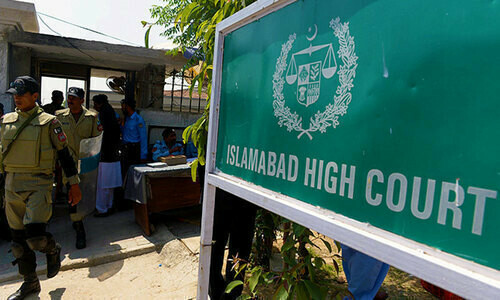
In December, the Islamabad High Court (IHC) was informed during the hearing of a case related to audio leaks that the government had not permitted any intelligence agency to tap audio conversations.
Attorney General for Pakistan (AGP) Mansoor Usman Awan had informed the high court during the hearing of a petition filed by ex-premier Imran Khan’s spouse Bushra Bibi, who was seeking action against a leaked conversation, allegedly featuring her and PTI leader Latif Khosa.
On Dec 6, the former first lady approached the IHC and contended that the recording beached the right to dignity and privacy ensured by Article 14 of the Constitution.
The application, filed in the IHC through Khosa, cited the principal secretary to the prime minister and secretaries of defence and interior as respondents.
In May, Justice Babar Sattar had said that prima facie no state official was authorised to surveil citizens and anyone doing so or aiding such an endeavour would be “liable for offences”. He had also prohibited cellular companies from sharing citizens’ data with agencies.
Law Minister Azam Nazeer Tarar informed the National Assembly that the government had authorised the country’s premier intelligence agency to intercept calls and messages or trace a call in the interest of national security or in the apprehension of a crime under Section 54 of the Pakistan Telecommunication (Re-organization) Act, 1996.
The minister said that it was not a new law rather it came into force in 1996 and further reshaped Section 54 of Pakistan Telecommunication re-organisation Act 1996.
He said no previous successive governments had changed this provision and still it was intact.
Section 54 of the act says, “Notwithstanding anything contained in any law for the time being in force, in the interest of national security or in the apprehension of any offence, the federal government may authorise any person or persons to intercept calls and messages or to trace calls through any telecommunication system.”
The minister said that the government from time to time issued notifications in this regard, adding that many incidents took place and culprits involved in heinous crimes were intercepted through interception of calls by the intelligence agencies under the said law.
‘Lack of privacy and human rights’
The PTI reacted to the notification and said that granting “unlimited powers for phone tapping to authorities” was synonymous with a “lack of privacy and human rights.”
“Lack of privacy and human rights is one big reason many companies are leaving Pakistan,” the party posted on its official X account. “SIFC initiative is already suffering, this will dent the mission further!”
Former human rights minister Shireen Mazari also denounced the move. She referred the move to George Orwell’s novel “1984”, which is about the use of censorship by totalitarian regimes to control information, manipulate reality, and suppress dissent.