Executive has to comply with SC orders: Justice Shah warns not acting on verdicts is ‘constitutional violation’


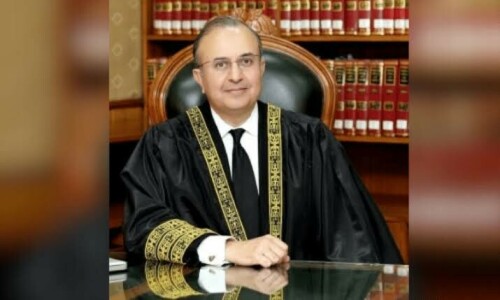
Supreme Court senior puisne judge Justice Mansoor Ali Shah on Saturday stressed that there could be no possibility of the top court’s orders going unimplemented as such a scenario would amount to a constitutional violation and the executive had no choice but to comply with court orders.
The remarks came a day after he similarly emphasised that the apex court’s orders were not merely recommendations or advisories, but legal mandates which must be followed. Legal observers are attaching great significance to these observations, particularly against the backdrop of recent legislation by Parliament aimed at circumventing the Supreme Court’s July 12 verdict in the reserved seats case. Parties in the ruling coalition had strongly criticised the verdict.
Addressing a conference regarding minority rights today, Justice Shah said: “It is not possible that a Supreme Court judgement is left unimplemented … let us make this clear that this can never happen that a Supreme Court judgement is not implemented. This cannot happen. It would be a constitutional violation if this was [even] thought about.
“Executive institutions have to recognise that they have no choice but to comply with the orders of the Supreme Court. I’m not saying this but the Constitution it [since this] is its structure and the Supreme Court draws this authority from the Constitution, not any other document.”
He said no one had the “choice to say ‘this is not right or [it is] wrong’”.
Justice Shah said the Constitution enshrined that there were judgements of a court and they should be implemented.
“This is the way. Either change the structure and make something else but the Constitution as it is and its structure, according to them the position is this.
“Any verdict cannot be disregarded or delayed otherwise you will uproot the entire legal system and you will upset the balance of the Constitution if you set out on this track that judgements should not be implemented. This is not possible.”
He also said that such an action would be against the separation of powers of state organs and also disbalance it. “Separation of powers is a core component of democracy and it should not be disturbed.”
Justice Shah said that to implement court orders was not a “courtesy” or a “burden” but was a “responsibility and constitutional obligation that you have to follow”.
He pointed out that there was a “delicate equilibrium” in the Constitution between state organs which should be respected.
“It is our obligation to maintain this balance and there should be no executive overreach of any kind. No one has the choice or prerogative to second guess a judgement if it is right or wrong. The prerogative is of the Supreme Court and once it makes an order, it has to be implemented. That is the system of this country and the Constituion of this country. If you want to make a new system then first do so and then we will talk about it.
“It is completely clear that [implementing court verdicts] is a constitutional duty and it has severe consequences if you don’t implement.”
On July 12, a 13-judge full bench of the apex court had declared that the opposition PTI was eligible to receive reserved seats for women and non-Muslims in the national and provincial assemblies, dealing a major setback to Prime Minister Shehbaz Sharif’s ruling coalition and potentially making the PTI single largest party in both houses of Parliament.
The Supreme Court had also declared the PTI a parliamentary party. The PML-N and PPP had strongly criticised the verdict and filed appeals against it in the apex court, along with the Election Commission of Pakistan.
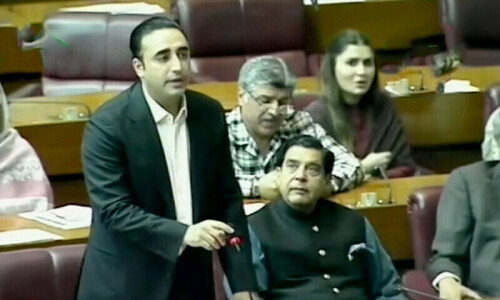
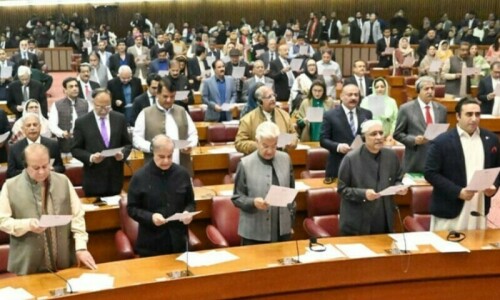
Meanwhile, the government on Tuesday bulldozed a controversial election law, apparently aimed at circumventing the Supreme Court verdict on reserved seats and sapping the expected strength of PTI in Parliament, through both houses of Parliament.
The law passed despite fierce protest by PTI members, who later approached the top court against the move.
Law Minister Azam Nazeer Tarar had claimed that the legislation was done in accordance with the constitutional scheme and in line with Article 51 and Article 106.
Speaking in the Senate, the minister had said it was Parliament’s right to legislate. “We cannot give this right to 17 individuals,” the minister said, an apparent reference to the apex court judges. He said there was a difference between the interpretation of the Constitution and re-writing the Green Book.
Changes to the elections law are set to become the latest legal battleground between the government, the opposition and the judiciary.
Legal experts say the ramifications of this wrangling could even extend to and redefine the scheme of separation of powers between the legislature, executive and judiciary, which in itself is quite a thorny issue.