Climate without borders


CLIMATE change does not need passports as it does not respect borders. Pakistan’s climate risks are rooted in shared ecosystems with its neighbours.
Major regional climatic developments and trends often cast a shadow on our national economic progress and well-being. Our climate threats originate in regional climate systems, often located in neighbouring countries. In fact, as climatic changes unfold, new ‘climate borders’ may emerge, requiring a distinct form of regional climate diplomacy.
From the Bay of Bengal to the Arabian Sea, and from the Tibetan Plateau to the Pamirs that link the Karakorams and Hindu Kush ranges, they are all part of the Himalayan mountain system defining Pakistan’s water resources, ecology, economy, and cultural heritage. As the entire region is recording profound changes in monsoon patterns, all our climate neighbours have begun to experience compound extreme weather events (CEWEs), whereby each climate disaster triggers another one.
Like Pakistan, our climate neighbours have also been witnessing CEWEs. In the South Asian landmass, dry areas have become drier with less than normal precipitation coupled with less cooling off at night. The frequency of hot summer days and hot summer nights has increased in the region. Record-setting daily temperatures have become more common. We have seen that heatwaves have often triggered torrential rains as experienced recently in several parts of India and Pakistan.
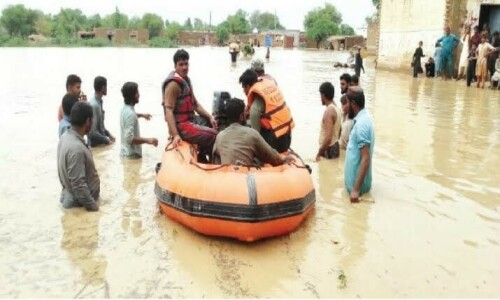
Record-high temperatures in Delhi and Lahore, for example, have resulted in record-breaking rains in both cities. It should be recognised that flooding is often attributed to weak governance rather than climate change. We have seen severe heatwaves in the upper Indus Basin result in downstream flooding. Record-high temperatures in Balochistan, Sindh, and KP have invited heavier monsoon rains in several parts of the country.
Emerging trends in slow-onset climate events have also become perceptible in recent years. Monsoon currents, for example, have begun to visit the upper mountain reaches in Chitral and Swat. Likewise, tropical storms in the coastal belts of Balochistan and Sindh are now influenced by disturbances in weather patterns in the Arabian Peninsula, affecting the frequency and intensity of rains in the Gulf region. Easterly winds from the Arabian Sea are resulting in increased torrential rains in Balochistan.
The challenge is to rethink the way in which we manage climate risks and plan adaptation.
Many urban centres in South Asia, from Karachi to Kolkata, have seen that droughts, heatwaves, and floods in their hinterland have spurred outward migration. Seasonal and permanent displacement and migration have become major sources of rapid urban growth. It is perhaps felt nowhere more strongly than in Karachi that has provided refuge to a steady stream of migrants from Dadu and Jacobabad propelled by high temperatures, from Tharparkar accelerated by prolonged droughts, and from Sajawal, Badin and Thatta because of seawater intrusion and salinisation.
Karachi has attracted communities from Balochistan and KP’s newly merged districts, plagued by land degradation and deforestation. Southern Punjab has also been contributing migrants in response to increasing hill torrents from Koh-i-Suleiman, a mountain range that separates the arid regions of Balochistan from the more fertile areas of Punjab, KP, and parts of Sindh.
A fundamental difference between traditional and non-traditional security challenges is the emergence of new climate borders. While traditional security is fundamentally concerned about geopolitical borders, the new climate frontiers are defined by transboundary impacts and the implications of change in climate systems and their cross-border impacts and implications.
The just-released Global Transboundary Climate Risk Report, 2023, by the Stockholm Environment Institute and others partnering in the initiative on ‘Adaptation Without Borders’, has drawn attention to some critical blind spots in national climate policies as well as the solutions offered by international climate diplomacy. It is an important report as it has pointed out — based on nine case studies — that transboundary climate risks also include those transmitted by national adaptation responses. The report has observed that national adaptation measures can have both positive and negative results across borders. In some instances, these can be negotiated to deliver shared benefits.
Climate risks impact local livelihoods, and critical sectors, such as finance, health and global supply chains, including agricultural commodities and manufacturing components. In the South Asian context, transboundary climate risks include shared rivers, mountain ranges, melting glaciers, flood disasters, and cross-border risks to infrastructure, and livelihoods.
The transboundary risk report has presented case studies, many of them of interest to Pakistan: agricultural commodities and food security, industrial supply chains, energy and sustainable energy transformation, finance, human health, mobility, livelihoods, well-being and equity issues. Amnesty International and other activist groups have long argued that climate justice must transcend national borders as climate hazards in one country have an impact across borders and affect its neighbours.
Each case study carries a message for Pakistan; perhaps the most central one is that policymakers and opinion leaders need to address their blind spots in climate policy. These risks are triggered by a climate hazard in one country affecting communities across the border. Likewise, adaptation actions in one country can be detrimental for neighbouring states. The risk report has called for more global cooperation on adaptation, with international policy fora as key drivers. National efforts to respond to climate change cannot succeed without understanding transboundary climate risks.
In a nutshell, the challenge is to rethink the way in which we manage climate risks and plan adaptation. The report sets out four potential areas to build resilience: i) create opportunities for innovative research on transboundary climate risks, ii) develop national/ regional indicators to track transboundary climate risks, iii) strengthen research based on climate scenarios, modelling and projections, and iv) negotiate preferred options to mitigate transboundary climate risks.
In order to manage regional climate risks and climate threats to security, non-traditional responses will be needed. Since most climate disasters are transboundary by nature, they require regional management approaches. Managing regional climate threats that do not respect national borders, will need process-oriented approaches that are not zero-sum but, instead, aspire to win-win scenarios.
The writer is an Islamabad-based climate change and sustainable development expert.
Published in Dawn, August 15th, 2024