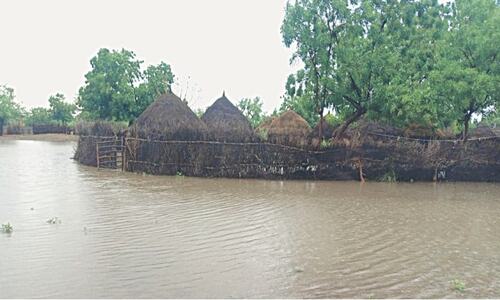
With a population of approximately 1.65 million people and 6m livestock, Tharparkar boasts a traditional desert economy in Sindh. While the region’s economic and social realities have always been harsh on its people, climate change has worsened its subsistence and survival risks.
Recently, unprecedented lightning strikes in this arid desert have caused significant casualties, with 14 human and 22 animal deaths recorded during the 2024 monsoon season.
According to the Association for Water, Applied Education & Renewable Energy’s report on “Unpredictable Danger: A Case of Lightning Strikes in Tharparkar”, 98 people and 1,756 animals have died from lightning in the district between 2019 and 2023.
Research studies reveal that the region experiences an estimated annual average of 100,000 lightning strikes, which is substantially higher than the global average of 25,000 due to its unique environmental and geographic characteristics. Nevertheless, additional verification is necessary based on recorded historical meteorological data.
As a result of the significant losses experienced, locals feel that rainfall in the Thar region, once celebrated as a blessing, has become a source of distress and fear. They feel threatened and are reluctant to work in the fields during the rainy sowing season, impacting their socio-economic well-being.
Frequent and dangerous lightning in the desert has become a source of distress with locals reluctant to work in fields impacting their socioeconomic well-being
At the same time, unseasonal rainfall and thunderstorms have necessitated urgent precautions to protect lives, highlighting increased awareness of the risks associated with unexpected downpours.
However, the community’s response to such risks is often rooted in untested myths, superstitions, religious beliefs and other folklore, leaving many individuals without the knowledge or means to implement effective precautionary measures.
During the monsoon season from June to September, the Thar region experiences heavy rainfall, creating optimum conditions for thunderstorms and lightning. High daytime temperatures and moist air from the Arabian Sea enhance convection currents, which are crucial for thunderstorm formation.
The flat and vast desert landscape allows thunderstorms to form and move unimpeded, while its high temperatures induce strong thermal convection, causing atmospheric instability and cloud formation. Interactions between cold and warm air masses generate electrical charges, resulting in frequent lightning strikes.
The high frequency of lightning events in the Thar region during the monsoon season can be primarily attributed to a unique combination of meteorological, geographical, topographical and climatic factors.
This complex interplay of contributing factors demands further investigation to elucidate the elementary mysteries that are still associated with lightning events to mitigate lightning risks in the region.
It requires scientific investigation with a holistic approach to determine the actual causes of this phenomenon and to debunk the myths associated with it. Independent research involving a multidisciplinary approach is needed, involving scientists, meteorologists, engineers, climate experts, and other experts from relevant fields.
The investigation should focus on identifying contributing factors and developing strategies for predicting and mitigating lightning risks. Additionally, implementing effective warning systems and emergency response measures is essential for protecting the population.
When developing safety guidelines and precautionary measures, it’s essential to consider the socio-technical characteristics unique to each region, especially in developing countries like Pakistan.
Factors such as literacy rates, income sources, religious and cultural practices, the nature of available shelter, and the technical aspects of local infrastructure play crucial roles in determining the applicability of global safety standards.
Therefore, safety guidelines must be tailored to fit these contextual factors to ensure their relevance and effectiveness. Additionally, these guidelines should be grounded in scientific data and rigorously tested within the local context to validate their efficacy and adaptability.
While community measures are crucial, government authorities must take collective action for immediate and long-term adaptation measures to ensure the safety and resilience of individuals in vulnerable areas, with a significant understanding of the socio-economic impacts of such climate events on the communities. Further, research and investigation must be undertaken to identify the root causes and subsequently develop a targeted mitigation strategy in the region.
In this regard, relevant forums should educate locals on safety measures and launch awareness campaigns by arranging workshops and community meetings to safeguard them against the hazards of lightning. Government, non-government organisations, academia, research institutes, and civil society must collaborate on mitigation and prevention efforts.
By implementing adaptation and mitigation measures, the region can protect its inhabitants and minimise the catastrophic consequences of lightning strikes in the future.
The writer is a research scholar at MUET Jamshoro.
Email: hussainshafqat.memon@gmail.com
Published in Dawn, The Business and Finance Weekly, August 19th, 2024