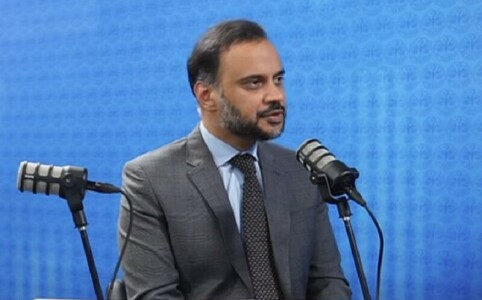
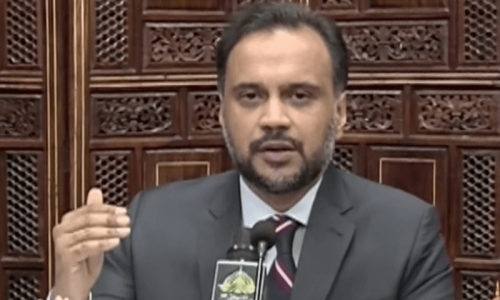
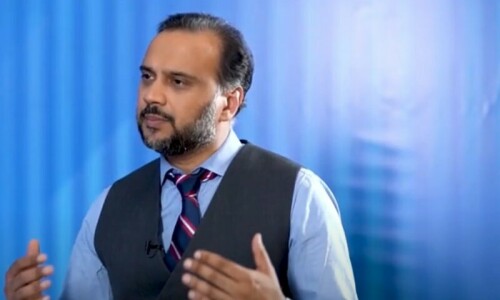
Murtaza Syed, a former acting governor of the State Bank of Pakistan (SBP), has said that “increasing fiscal space by restructuring” debt was crucial to rescue countries from disorderly defaults.
Writing in The Economist on Wednesday, Syed recalled his article from last year where he said the International Monetary Fund (IMF) and Pakistani policymakers were “flirting with disaster by pretending that the country’s public debt was sustainable”.
Pakistan and the IMF signed a 37-month staff-level agreement in July for $7 billion with the approval of the new loan tied to firm commitments from China, Saudi Arabia, and the UAE that they would roll over their combined debt of $12bn.
Due to foreign exchange difficulties and an inability to repay its loans, Pakistan has been securing one-year extensions. However, it is now seeking rollovers for three to five years to access IMF credit, address uncertainty, and get sufficient time to fix structural flaws and regain its external sector sustainability.
“For this to happen, a taboo must be broken and innovative thinking is needed on dealing with new creditors and how the IMF approaches debt in its country programmes,” he wrote.
In the current article, Syed cited examples of various countries where debt servicing was crowding out development spending needed to improve lives.
He pointed out that in Pakistan, interest payments were almost “three times as high as spending on investment and three and a half times spending on education”.
“These countries are gambling for resurrection by increasing taxes and slashing spending while praying for a growth miracle,” he said.
He, however, added that this increased the chances of default and unravelling of the country’s social fabric.
Regarding the taboo, he said it concerned the government’s “fear of debt restructuring”.
On Wednesday, global credit rating agency Moody’s had upgraded Pakistan’s rating to Caa2, but explained that the rating continued to reflect its “very weak debt affordability, which drives high debt sustainability risk” as it forecasted interest payments to continue absorbing about half of government revenue over the two to three years.
“The Caa2 rating also incorporates the country’s weak governance and high political uncertainty,” it added.
As for debt restructuring, the government feared being “perceived as inept economic managers, possible legal action by creditors, and the consequences for future external funding”, Murtaza Syed wrote in the article.
It is possible, according to Syed, to overcome this fear. He highlighted that cover from legal action in international courts “can be provided by major official creditors, as was done for Iraq, or could be automatically triggered by an IMF assessment that debt is unsustainable”.
As for the market penalty for restructuring, Syed wrote, drawing from international evidence, that the penalty “is much lower and more short-lived than commonly feared especially if the restructuring improves the country’s growth prospects”.
“In this context, governments must not be afraid of restructuring lower-seniority commercial debt, which costs much more precisely because of this credit risk,” he wrote.
Syed also pointed out that “fresh thinking” was needed to accommodate creditors such as China and Gulf states, adding that it needed to be incentivised and IMF should assist debtor countries to bring them to the table.
“One idea is to allow the majority official creditor that offers debt relief the right to force other creditors to agree to a similar dilution of their claims,” he said, citing the example of the Paris Club of creditors where the right to cram down on other creditors already exists.
“To preserve social stability and development prospects in poor countries, the broken system of debt restructuring must be fixed,” he said, adding that for that to happen “debtors must become more powerful advocates for their future generations. And the international community must become more receptive to debt relief”.