BEING surrounded by chaos and violence in the country, a constant state of depression and anxiety, leading to hopelessness, had become the new normal. In this new normal, only the instinctual will to survive and ethical duty to our loved ones kept us alive and relatively sane.
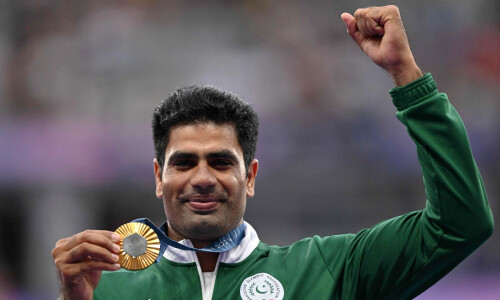
But then, like a rising phoenix, came Arshad Nadeem with his Olympic gold medal. There was something about that moment on Aug 8, and something about Arshad, which immediately convinced me that this was something far more important than an Olympic gold medal.
Unique achievement: To understand the implications of Arshad’s achievement, his unique sporting feat has to be understood first. Firstly, unlike other sports (for example, cricket), track and field are the centrepiece of Olympic events, with widespread global participation. Secondly, unlike cricket and hockey, javelin throwing is an individual achievement. You are the one who solely determines your glory or defeat. Thirdly, Arshad not only won a gold medal, but broke the previous Olympic record of 90.57 metres — not once, but twice (92.97m and 91.79m).
This was a rare combination of victory, world-class excellence and making history. Fourthly, while Jahangir Khan’s and Jansher Khan’s squash brilliance are certainly comparable to Arshad’s achievements, Arshad still stands out because of his impoverished rural and working-class background and lack of family sporting history.
Hopelessness to dreams: Arshad’s journey, from hopeless personal and societal conditions to personal greatest achievement, is unique. The four horsemen of apocalyptic pre-destruction were present: the obstacles of being working class, the geographical backwardness of his hometown, the anti-sport culture of this society, and the complete lack of encouragement or adequate facilities in the neglected sport of javelin throwing in Pakistan (as compared to cricket or hockey). In the age-old debate of free will versus determinism, Arshad is the poster boy for human free will; and if Nietzsche’s ‘Will to Power’ philosophy could be captured by a sporting example, Arshad’s javelin throwing ability would be a leading candidate.
Arshad Nadeem’s journey offers optimism that all is not lost in this sea of hopelessness.
More importantly, in a country like Pakistan, where 60 per cent of the population is under 30 years and where there is a working-class majority, Arshad’s journey offers optimism that all is not lost in this sea of hopelessness. Even if there’s no Olympic gold medal, the individual free will of working-class and middle-class youths can still make a difference.
Foundations of transformation: After thanking Allah and acknowledging the prayers of the nation for him, Arshad gave credit for his historic achievement to his family, especially his mother and key individuals in his life, ie, his coaches and doctor. What Arshad Nadeem’s journey tells us is not a blueprint for societal transformation, but a path to personal greatness despite no societal change as such.
Pakistan is in a state of chaos and violence, with a suicidal, mediocrity-loving and globally humiliated elite in charge. In such an anarchic and repressive state, the path to survival, happiness and achievement lies through reliance on family and friendship structures, as well as individual efforts to transform each other’s lives. Regardless of the destruction around us, we must transform one another’s life and keep hope alive. Groups, political parties and institutions will build on such individual examples in the future to transform society.
Extraordinary personality: My educational background at LSE and Cambridge did not teach me the qualities which Arshad Nadeem, at the tender age of 27 years, did. For example, when asked whether Neeraj Chopra was his competition, he said that his competition was with himself; ie, his own limitations. His relationship with Neeraj is a classic example of being a world-class athlete without hating or being mean to your rivals. The absence of such hate or meanness is rare among successful people.
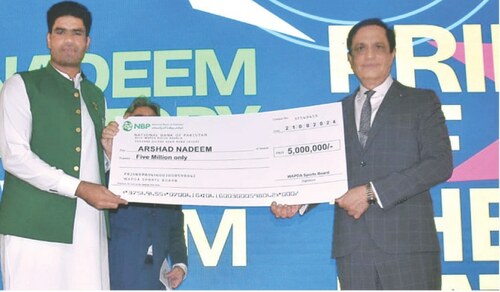
Moreover, he is confident without being arrogant or showing hubris; he is genuinely humble in victory without being superficial. Despite personal greatness and now the showering of wealth, his sense of social responsibility led him to demand better facilities for his hometown and sports facilities for the youth. Finally, he is not merely a world-class athlete but also a performer who captured the imagination of the crowd by the way he performed during the javelin throwing event at the Paris Olympics.
Religiosity, not fanaticism: Arshad Nadeem is a religious man who credits his victory to the blessings of Allah. But his religiosity had led to personal transformation and greatness and not to fanaticism. His near-impossible journey to success lays bare three foundational elements of his faith. Firstly, belief (not certainty) that if he works hard and excels, he will be rewarded. Secondly, remarkable patience (not immediate gratification) bridging the hard and long distance between belief and success. Thirdly, gratitude (not endless greed) for whatever Allah has granted him. Arshad Nadeem is the perfect example for the Pakistani youth regarding mutual reinforcement of religiosity and worldly success.
Beyond sports: No number of internet firewalls or amount of propaganda through textbooks or media can ever beat the nationalism instilled in Pakistanis by a single Olympian performance by Arshad. Sports is a key strategic tool of nationalism. Secondly, there was no disagreement between various political, social and religious forces on his achievement. Thus, this violently divided, youthful society can be healed through sports. Thirdly, Arshad Nadeem repeatedly described himself as not merely a Pakistani but a South Asian athlete. Thus, the forces of Islamist extremism in Pakistan and Hindutva in India could not prevent such South Asian solidarity.
I fear that my optimism might be short-lived, because, firstly, the money and privileges being showered on him might commodify his pure soul. Secondly, the government’s desire to take credit for his achievement will politicise his national achievement. Thirdly, the rivalry between India and Pakistan might ultimately poison their South Asian solidarity. But let us at least savour this moment when, after a long time, Arshad Nadeem made us all feel like a proud, not humiliated, nation.
The writer is a lawyer.
Published in Dawn, August 31st, 2024