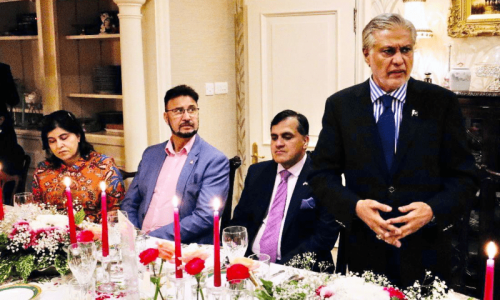
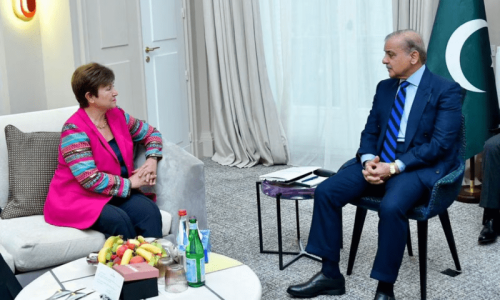
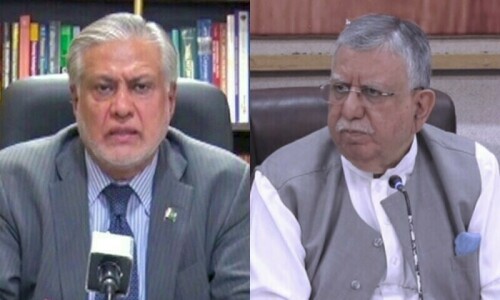
IN remarks reported widely in the media, Foreign Minister Ishaq Dar has been quoted complaining that the IMF is playing politics with Pakistan and changing the goalposts at critical moments to delay the disbursement of funds.
Those who know him and have spoken with him over the years know his propensity to speak at length off the cuff and also know that he harbours great mistrust, bordering on animus sometimes, towards the IMF. This is not the first time he has rolled out the ‘geopolitics’ card when talking about delays in getting Fund approval for disbursement of the next tranche. He did the same as finance minister in 1999 and again in 2022, 2023.
But is it true? More likely what Pakistan is facing is an absence of geopolitics on the IMF board. Between 2001 and 2021, the country had more or less a free run of things at the Fund, when programme approvals came swiftly and reviews went smoothly and waivers were granted without too much trouble. It is not difficult to note what these dates denote: the arrival and continued deployment of American troops in Afghanistan. Since August 2021, when the deployment ended, so did Pakistan’s ‘special treatment’ at the Fund.
Dar wishes to argue that the Fund held out completion of the reviews under the last Extended Fund Facility “for eight months”, as he did in his reported remarks given in London, due to geopolitics. He has been quoted as saying the Fund wanted to push Pakistan into a default. His reference was to the months he was finance minister from September 2022 till June 2023. A Fund review did indeed stall during those months with the programme drawing to a close, with the last few reviews unfinished.
But if the IMF was trying to push Pakistan into default, why did the same Fund mobilise so expeditiously to arrange a Stand-by Arrangement (SBA) in July 2023, literally weeks after the Dar government handed over power to an interim set-up? Why try to push a country into default, then move rapidly to rescue the same country at the last minute and prevent such a default?
More likely what Pakistan is facing is an absence of geopolitics on the IMF board.
The answer is simple. The Fund was not trying to push Pakistan into default or playing geopolitics. It was simply trying to get some commitments to be upheld, which were not being upheld, and in the absence of geopolitics, Pakistan’s traditional resort to external bailouts had shrunk considerably.
Consider a few numbers to get a sense of how things moved from that July to today. Take a look at where Pakistan’s projected macro targets were meant to be as per the projections in the September 2022 review, when Dar was finance minister, and July 2023, when he handed over power to an interim set-up.
In September 2022, FBR revenues for the ongoing fiscal year (FY25) were projected to be Rs9.7 trillion. In the July SBA, this projection had risen to Rs11tr. One could look at these numbers and argue that the Fund shifted the goalposts by raising the revenue target by more than a trillion rupees.
But then look at the other side of the equation. In September 2022, current expenditures for that year were meant to come in at Rs11.1tr by year-end. This projection had then been revised up to Rs12.3tr during the review, an upward revision of more than one trillion rupees! By the time the year ended in June 2023, current expenditures came in at Rs14.4tr, overshooting their newly revised target by more than two trillion rupees!
Targets were strictly adhered to in the SBA of July 2023, the main reason why the country was able to pull back from the brink of a catastrophic default. But the memory of agreeing to targets then — either failing or refusing to abide by them, and thereby prolonging the spell of macroeconomic uncertainty in the country — could be easy to forget. Go through the targets one by one. From fiscal to external sector, the story in the past few years is the same: weak ownership of the stabilisation programme.
None of this should be surprising. The government that took power following the April 2022 vote of no-confidence inherited an economy poised for massive instability with a runaway situation on the current account and the fiscal deficit. Faced with a ferocious political contest at the same time as it had to undertake a painful economic adjustment, the government dithered.
Prior to this, the outgoing government of the PTI had similarly found it very difficult to unwind the Covid stimulus and resume the Fund programme, and as its political challenges mounted in the run-up to the vote of no-confidence, its commitment to adhere to Fund targets diminished. In a sense, from 2020 onwards, all governments (except for the interim set-up) have been unable to really walk the path of adjustment, due in large part to the intensity of the political competition plaguing the country since then.
It might be tempting for Dar to blame the IMF for this, but it is difficult to believe that this inability to adhere to commitments would be without consequences. The more the country dithers on its own commitment to its own macroeconomic stabilisation, the less its creditors will feel assured that this country can meet its external debt service obligations in a timely manner. The more this feeling grows, the more assurances they will need before becoming engaged with this country.
It is as simple as that. It is very difficult to believe that there is any geopolitical interest of any country out there which is advanced by watching Pakistan default. Such an event serves neither the foreign policy interests of any of the larger powers Pakistan is in debt to, nor does it serve the economic interests of anyone. More than outsiders, the government must realise that safeguarding the hard-fought stability of our time is its singular responsibility.
The writer is a business and economy journalist.
Published in Dawn, September 12th, 2024