Israel claims top Hezbollah scalp in Beirut strike


• 12 killed, 66 injured in attack on high-rise in city’s suburbs
• Ibrahim Aqil was wanted by US for role in 1983 embassy bombing
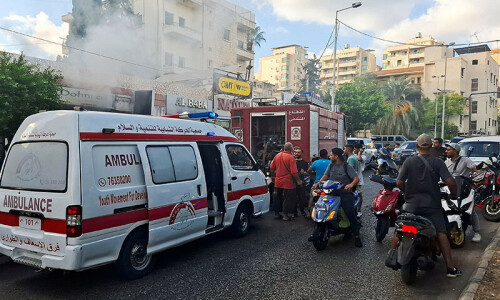
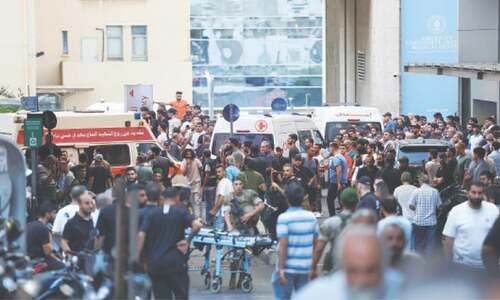
BEIRUT: Israel claimed it had killed the commander of an elite Hezbollah unit, in a strike on Friday that Lebanese officials said left 12 dead and dozens wounded in the country’s capital.
Ibrahim Aqil, who was also wanted by the United States for involvement in the 1983 bombing of the US embassy in Beirut, was among those said to have been killed in the strike.
Journalists at the scene said the blast had left a massive crater and gutted the lower floors of a high-rise building in the Lebanese capital’s southern suburbs.
The killing of Aqil was the second targeting of a senior Hezbollah commander since the start of the war on Gaza, following another Israeli strike in Beirut that killed Fuad Shukr in July.
It also came after two waves of explosions, on Tuesday and Wednesday, of communication devices used by Hezbollah members, which the group blamed on Israel, that killed dozens and left thousands injured.
The Israeli military said on Friday it conducted a “targeted strike” to kill Aqil and which also killed around 10 other senior commanders.
Lebanon’s health ministry said the attack killed 12 people and wounded 66 more.
Earlier, a source close to Hezbollah, requesting anonymity to discuss sensitive matters, said the strike had killed Aqil.
Hezbollah has not officially confirmed his death, but it said after the strike that it targeted with rockets an Israeli intelligence base it blamed for unspecified “assassinations”.
The United States had offered a $7 million reward for information on Aqil, describing him as a “principal member” of the organisation that claimed the 1983 embassy bombing, which killed 63 people.
Israeli troops and Hezbollah fighters have battled each other along the Israel-Lebanon border since October 7.
The focus of Israel’s firepower for nearly a year has been on Gaza, but recently, the focus of the war has shifted dramatically to Israel’s northern border.

Months of near-daily border clashes have killed hundreds in Lebanon, most of them fighters, and dozens in Israel, and forced thousands on both sides to flee their homes.
On Tuesday and Wednesday, Hezbollah was hit by an unprecedented attack that it has blamed on Israel, though Israel has yet to comment.
The attack saw thousands of Hezbollah operatives’ communication devices explode across two days, killing 37 people and wounding thousands more.
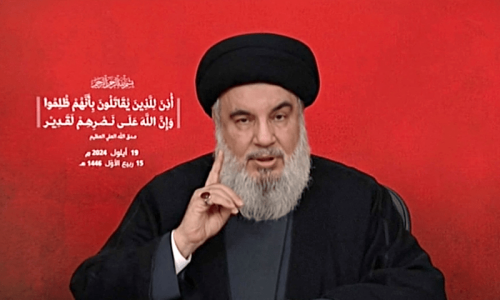
Hezbollah chief Hassan Nasrallah vowed on Thursday that Israel would face retribution for the blasts.
Earlier on Friday, Israel said Hezbollah had fired dozens of rockets from Lebanon following air strikes which destroyed dozens of the militant group’s launchers.
‘Fear of wider war’
Residents of Marjayoun, a Lebanese town close to the border, said the overnight bombardment was among the heaviest since the border clashes began last October.
“We were very scared, especially for my grandchildren,” said Nuha Abdo, 62.
“We were moving them from one room to another.” Clothing store owner Elie Rmeih, 45, counted more than 50 strikes.
“It was a terrifying scene and unlike anything we have experienced since the escalation began.
“We live in fear of a wider war, you don’t know where to go.”
Calls for restraint
International mediators have been scrambling to stop the Gaza war from turning into an all-out regional conflict.
US Secretary of State Antony Blinken, who has tried to salvage efforts for a Gaza ceasefire and hostage release deal, called for restraint on all sides.
“We don’t want to see any escalatory actions by any party” that would endanger the goal of a Gaza ceasefire, he said.
US Defence Secretary Lloyd Austin voiced fresh concern on Friday over escalation between Israel and Hezbollah during his sixth call with his Israeli counterpart in less than a week, and urged a diplomatic resolution to the crisis.
Austin’s focus on diplomacy in his statement came after Israeli Defence Minister Yoav Gallant spoke of a new phase of war.
The Pentagon said in a statement that Austin reiterated to Gallant “his concern over the current escalation of exchanges between Israel and Lebanese Hezbollah”.
That language was identical to a statement from Major General Patrick Ryder, a Pentagon spokesperson, on Thursday after another call between Austin and Gallant.
Published in Dawn, September 21st, 2024