• Military escalation not in Tel Aviv’s ‘best interest’, says US
• Netanyahu warns Lebanese group will ‘understand the message’
• Hezbollah says it hit Israeli targets in ‘initial response’ to pager attacks
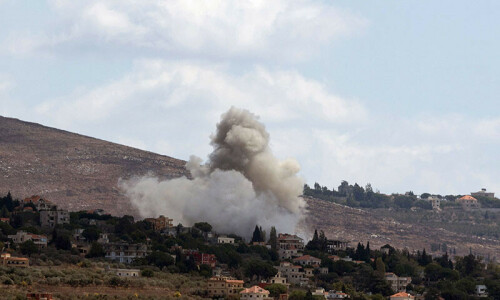
BEIRUT: Hezbollah and Israel exchanged heavy fire into Sunday, as the Lebanese group sent rockets deep into northern Israeli territory after facing some of the most intense bombardment in almost a year of conflict.
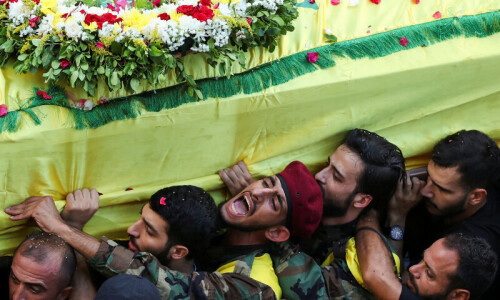
Hezbollah deputy chief Naim Qassem told mourners at the funeral of one of the group’s commanders killed last week in Beirut, “We have entered a new phase, the title of which is the open-ended battle of reckoning”.
Israeli Defence Minister Yoav Gallant said operations would continue until it was safe for evacuated people on his side of the border to return — also setting the stage for a long conflict as Hezbollah has vowed to fight on until a ceasefire in the parallel Gaza war.
The conflict — which sharply escalated over the past week — has raged since Iran-backed Hezbollah opened a second front against Israel, saying it was acting in solidarity with Palestinians facing an Israeli offensive further south in Gaza.
On Tuesday and Wednesday, thousands of pagers and walkie-talkies used by Hezbollah members exploded in an attack widely blamed on Israel but which it has not confirmed or denied responsibility for.
The next day, Israel launched its heaviest bombardment of Lebanon yet. Friday saw Hezbollah’s senior commander and founder of the elite Radwan forces, Ibrahim Aqil, killed along with several military figures in a strike on Beirut’s southern suburb.
Saturday again saw unprecedented bombardment that the Israeli military said struck around 290 targets.
“In recent days we have inflicted a series of blows on Hezbollah that it never imagined,” Israeli Prime Minister Benjamin Netanyahu said in a video statement on Sunday.
“If Hezbollah has not understood the message, I promise you, it will understand the message.”
Sirens sound, schools shut
Speaking at Aqil’s funeral in Beirut’s southern suburbs on Sunday afternoon, Hezbollah’s Qassem said Israel was seeking to paralyse the group, but would not succeed.
Qassem said Israel’s escalation of the conflict would lead to further displacement of its own citizens.
Israel has closed schools, restricted gatherings in the north and ordered hospitals there to move patients and staff to protected areas — many have secured or underground facilities designed to withstand rocket fire.
Air raid sirens sounded constantly in Israel on Sunday. About 150 rockets, cruise missiles and drones were fired at Israel overnight and into Sunday, most of which were intercepted by air defences, including an “aerial target” that came from the east, the military said.
Several buildings were struck, including a house badly damaged near the Israeli city of Haifa. Rescue teams treated wounded but there were no reports of deaths. Residents had been instructed to stay near bomb shelters and safe rooms.
Hezbollah said it hit a barracks and another Israeli position with squadrons of attack drones on Sunday, and also launched rockets at military-industrial facilities in an “initial response” to the device attacks last week.
An official in the Islamic Resistance in Iraq, a grouping of Iran-backed armed factions, said they launched cruise missile and explosive drone attacks at Israel at dawn on Sunday as part of “a new phase in our support front” with Lebanon.
UN special coordinator in Lebanon Jeanine Hennis-Plasscharet said in a post on X that “with the region on the brink of an imminent catastrophe, it cannot be overstated enough: there is NO military solution that will make either side safer”.
Meanwhile, White House National Security spokesman John Kirby said on Sunday that a regional military escalation is not in Israel’s “best interest”.
“We don’t believe that escalating this military conflict is in their best interest,” Kirby said on ABC’s ‘This Week,’ adding that the United States was “saying this directly to our Israeli counterparts.”
“The tensions are much higher now than they were even just a few days ago,” he said.
But Kirby added that “we still believe that there can be time and space for a diplomatic solution here and that’s what we’re working on.”
Published in Dawn, September 23rd, 2024