South Asia floods expose gaps in regional climate cooperation


As more extreme rainfall hits South Asia leading to floods that do not recognise national borders, regional countries must work together more to combat the mutual threat, experts said.
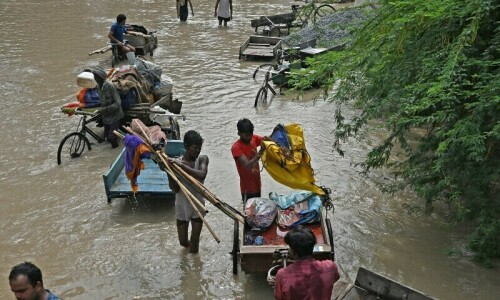
Heavy rains led to flash floods and landslides that killed some 200 people in Nepal last month in two days of incessant rains caused by low pressure in the Bay of Bengal and neighbouring parts of India. In August, a flash flood killed at least 71 near the border of India and Bangladesh.
Some 80 per cent of major South Asian cities are at risk of flooding which could cost the region $215 billion a year by 2030, a 2021 report published by the World Bank said.
But despite larger and more frequent cross-border disasters, a trust deficit between South Asian countries has meant they have struggled to work together and have instead often resorted to mutual recrimination.

India is Nepal’s biggest trading partner, but the two also have several border disputes. Similarly, Bangladesh and India have strong economic ties but are in dispute over water sharing and the killing of people crossing the border illegally.
“No country in the region trusts others when it comes to riparian management, thanks to the political differences,” said Harsh Vasani, a professor of international studies at Flame University in India.
A Bangladesh government adviser said the August flood was caused by India releasing water from a dam upstream without warning into a river flowing into Bangladesh.
India’s Ministry of External Affairs said live data had been shared with Bangladesh about the rising waters, but had stopped due to a power cut caused by the floods.
It said the area had seen the “heaviest rains of this year” and in any case most of the water came from catchments downstream from the dam.
“Floods on the common rivers between India and Bangladesh are a shared problem inflicting sufferings to people on both sides and requires close mutual cooperation towards resolving them,” the ministry said in a statement.
Early warnings
Climate change is likely to trigger more frequent and more extreme weather events, such as the August flood, said Shaikh Rokon, head of Riverine People, a Bangladesh non-profit promoting stewardship of rivers and inshore wetlands.
“But climate change should not be made into a scapegoat for explaining away preparedness gaps within and between countries,” Rokon said.
The United Nations’ 2015 Sendai Framework for Disaster Risk Reduction says countries should provide early warnings and help communities make preparations before floods hit.
Forecasts and timely messaging have brought the death toll from monsoon floods to near zero in vulnerable communities in South Asia, said Dharam Raj Uprety from the Britain-based development organisation Practical Action, which has implemented flood resilience projects in Bangladesh and Nepal.

But while monsoon floods can be predicted 10 to 12 days ahead, flash floods caused by rain give much less warning and that means alerting communities is a much bigger challenge, said Sardar Uday Raihan, executive engineer at the Flood Forecasting and Warning Centre in Bangladesh.
Bangladesh and India set up a joint river commission in 1972 to foster cooperation on flood warnings for the 54 rivers that cross their border. India and Nepal have a similar commission.
But it would help if there were real-time data sharing on water released from dams and upstream water levels, Raihan said.
Regional cooperation
Joint action is a rarity, said Sumit Vij, a professor at Wageningen University in the Netherlands. It makes little sense for each country to have its own strategy to adapt to the same floods, he said.
“Though we often stress on locally-led adaptation, we actually need countries and areas over the same river basin or climatic region to align their adaptation efforts and share resources to deal with disasters,” Vij said.
One rare example of cooperation has been over the Koshi and Karnali rivers that flow from Nepal to India.
The project, implemented by Practical Action and other organisations, upgraded weather stations and set up a system to send mobile telephone alerts of rising waters.

While it was carried out mainly on the Nepalese side of the border, the project also benefited Indians living near the frontier who could also receive the flood warnings.
At present, Bangladesh and India have agreements on only a few of the rivers that pass between them. The two countries should formulate a single comprehensive agreement on all their 54 transboundary rivers instead of pursuing lengthy negotiations for each river separately, Vij said.
“We, South Asian nations, need to work together,” he said.