North Korea blows up roads connecting it to the South


North Korea blew up sections of the deeply symbolic roads connecting it to the South on Tuesday, Seoul’s military said, adding it had conducted a “counter-fire” operation in response.
Pyongyang’s military last week vowed to permanently seal its southern border after spending months laying mines and building anti-tank barriers in the wake of leader Kim Jong Un declaring the South his country’s “principal enemy”.
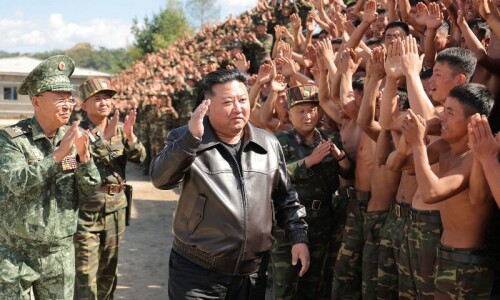
The North also accused Seoul of using drones to drop anti-regime propaganda leaflets on the capital Pyongyang, with Kim convening a security meeting to direct a plan of “immediate military action” in response, state media reported on Tuesday.
“North Korea has detonated parts of the Gyeongui and Donghae roads north of the Military Demarcation Line,” the Joint Chiefs of Staff said on Tuesday, referring to inter-Korean infrastructure that once connected the two countries.
“There has been no damage to our military, and our forces conducted counter-fire in areas south of the MDL,” it added.
The roads have long been shuttered, but destroying them sends a clear message that Kim is not prepared to negotiate with the South, experts said.
“This is a practical military measure related to the hostile dual-state system that North Korea has frequently mentioned,” Yang Moo-jin, president of the University of North Korean Studies in Seoul, told AFP.
The North may also be looking to erect more physical barriers along the border, Yang said, adding that the road detonations could be “preparatory work.”
South Korea’s military released video footage showing North Korean soldiers in military uniforms ahead of a huge explosion, which emitted thick billowing smoke as it blew up sections of the Gyeongui road.
More footage, apparently from after the blasts, showed excavators digging, while soldiers worked as large red trucks arrived.
The Seoul military also released separate footage showing North Korea blowing up a section of the Donghae road, on the east coast.
South Korea’s unification ministry slammed the North for what it called an “extremely abnormal” provocation, adding that Seoul had shouldered millions in costs for building the infrastructure.
“North Korea still has repayment obligations regarding this funding,” it added.
China, a traditional ally of the North, called on all parties “to avoid further escalation of conflicts” on the peninsula, a foreign ministry spokesperson said.
Drone denial
Seoul’s military initially denied sending drones north but has subsequently declined to comment, even as Pyongyang has blamed them directly, warning it would consider it “a declaration of war” if another drone was detected.
Later on Tuesday, the powerful sister of North Korean leader Kim Jong Un released a statement, saying Pyongyang has secured “clear evidence” that the South Korean military was behind the drones that reached Pyongyang. “The provocateurs will have to pay a dear price,” Kim Yo Jong said.
Activist groups in the South have long sent propaganda northwards, typically carried by balloons, but enthusiasts are also known to have flown small, hard-to-detect drones into the North.
Unlike conventional drones made of metal, the devices they used were constructed from expanded polypropylene, similar to Styrofoam, allowing them to go undetected by both South and North Korean authorities, according to enthusiasts who spoke to local media.
At Kim’s meeting Monday, officials heard a report on the “enemy’s serious provocation”, said KCNA, adding Kim had “expressed a tough political and military stand”.
The North has said the United States, which has a military alliance with South Korea, should also be held responsible.
North Korea has itself sent drones southwards — in 2022, five of Pyongyang’s drones crossed the border, prompting the South Korean military to fire warning shots and deploy fighter jets.
The jets failed to shoot down any of the drones.
In July, Seoul said it would deploy drone-melting lasers this year, adding the South’s ability to respond to provocations would be “significantly enhanced”.
Now, it is a question of whether “North Korea will respond by sending drones into the South or take strong action if drones infiltrate its territory again”, said Cheong Seong-chang of the Sejong Institute.