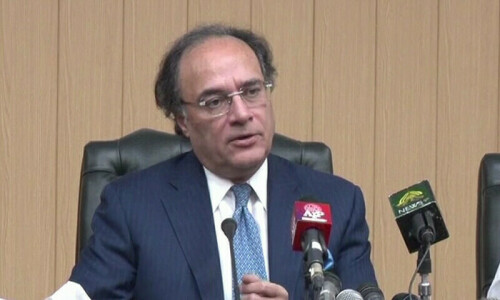
Finance Minister Muhammad Aurangzeb told Reuters that Pakistan is targeting around $1 billion in a formal request for funding from the International Monetary Fund (IMF) facility that helps manage external shocks.
“We have formally requested to be considered for this facility,” Aurangzeb said in an interview on the sidelines of the IMF/World Bank autumn meetings in Washington.
The IMF agreed to a bailout for Pakistan last month but has further funding available via its Resilience and Sustainability Trust (RST).
The country is also in talks with the Asian Infrastructure Investment Bank for a credit enhancement for a planned Panda bond, with an initial issue of $200-250 million.
Govt aims to privatise PIA by November
Pakistan is also hoping to finalise both the delayed privatisation of Pakistan International Airlines (PIA) and the outsourcing of Islamabad’s international airport in November, Aurangzeb said. He spoke to AFP at the World Bank’s headquarters in Washington.
During a previous interview with AFP in April, Aurangzeb had said he hoped the privatisation of state-owned PIA could be completed by June 2024.
Speaking on Wednesday, the finance minister said the five-month delay was down to two factors: ensuring macroeconomic stability, and doing the proper due diligence of the interested parties.
“The reality is, when any foreign investor comes in, or even the local investor, who are going to put in a substantial amount of money, they want to ensure that the foundation is there,” he said, referring to macroeconomic factors.
Aurangzeb noted that potential bidders for both PIA and Islamabad airport also required scrutiny, another factor in the delay.
“Therefore it’s ultimately the cabinet which approved the extension in the timelines so people can do their due diligence before they make these submissions,” he said.
Brink of default
Aurangzeb said Pakistan had been behind on existing profit and dividend repayments when the current government took office, and had taken steps to remedy that after making progress on macroeconomic stability.
The country came to the brink of default last year as the economy shriveled amid political chaos following catastrophic 2022 monsoon floods and decades of mismanagement, as well as a global economic downturn.
Inflation peaked at 38 per cent, but has since dropped to less than seven pc, after the central bank maintained sky-high interest rates, amid other government tightening measures, including import bans to preserve foreign exchange.
Last month, the IMF approved a $7 billion loan, Pakistan’s 24th such payout from the multilateral lender since 1958.
Aurangzeb touted progress on the country’s current account deficit and the stabilisation of the rupee, which has depreciated against the US dollar by about 65pc since 2020.
“In May and June on the back of this macroeconomic stability and building up on our reserves, we paid more than $2bn to our existing international investors,” he said.
Pakistan’s gross public debt currently stands at 69pc of GDP, according to the IMF, or roughly $258bn.
‘Saturation point’
Alongside privatising state-owned enterprises (SOEs), Pakistan’s IMF deal also rests on increasing its tax base, and reforming of the country’s power sector.
Aurangzeb told AFP there was a common theme between all three major issues.
“Tax, power, SOE: There’s leakage, there’s theft, there’s corruption, right?” he said. “And we have to deal with all of that.”
But he dismissed media reports that the government was not serious about broadening its tax base, saying that the tax take had risen by 29pc in the last fiscal year, which overlapped with a prior caretaker government, and was targeted to rise by a further 40pc in the current fiscal year.
In a nation of more than 240 million people where most jobs are in the informal sector, only 5.2m filed income tax returns in 2022.
“People who are not paying up, they need to start paying for the simple reason that we have reached a saturation point of the people who are paying,” he said.
“The salaried class, the manufacturing industry, reached a saturation point. And this cannot go forward,” he added.
The government was also committed to doing a better job of taxing certain sectors of the economy, he said, naming real estate, retail, retail distributors, and agriculture.