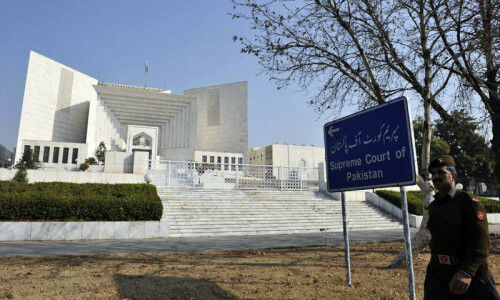
ISLAMABAD: PTI leader Salman Akram Raja on Tuesday moved a petition before the Supreme Court seeking to review its Sept 30 verdict which upheld Election Commission of Pakistan (ECP)’s plea relating to the appointment of the Punjab election tribunals.
Mr Raja who lost the Feb 8 general elections from NA-128 pleaded through the review petition that the Sept 30 judgement was decided by the Supreme Court without adverting to the maintainability of the cases.
Earlier in July 4, the Supreme Court had suspended Lahore High Court’s June 12 notification of constituting eight election tribunals in Punjab, as well as the high court’s determination that its chief justice had the final say in the appointment of tribunals to settle election disputes.
The petitioner has sought a determination from the apex court that the executive authority to allocate a petition to the election tribunals resides solely with LHC chief justice or the relevant high courts and not ECP and that the consultation meetings between the chief justice Lahore High Court (LHC) and ECP should not be used as a reason to supersede the nominations of the election tribunals.
Petition says Sept 30 judgement decided by Supreme Court without adverting to maintainability of cases
The review petition pleaded that the parties were not heard on this preliminary objections, which amounted to violation of due rights of fair trial as enshrined under Article 10A of the Constitution.
The petition contended that the Sept 30 judgement contained inherent contradictions especially where the order held that there was no need of deciding these cases when consensus had been reached between the ECP and the LHC on the appointment of tribunals.
In its Sept 30 judgement, the Supreme Court had held that since the matter had been amicably resolved there was no need to decide these cases and had appreciated the two officials (CJ-LHC and ECP) for resolving the issue by realising their respective constitutional and legal responsibilities.
The review petition pleaded that the Sept 30 judgement had ventured far beyond by giving effect to what was being claimed as a consensus between LHC and ECP. Moreover, the remarks made in the judgment in relation to the future applicability of LHC’s order were liable to be expunged and recalled.
The petition pleaded that the ramification of the Sept 30 judgement extended well beyond the immediate impact on the petitioner’s rights and created a situation where the executive bodies could be allowed to act with disregard for established legal principles and judicial authority.
This potential for arbitrary governance undermines the principles of independence of judiciary and rule of the law. The Supreme Court as the custodian of constitutional democracy and the guardian of fundamental rights must exercise in its rulings to ensure they do not become tools for perpetuating undemocratic practices, the petition stated.
It contended that the Sept 30 judgement had created a misleading narrative, which does not fully account for the officeholders of the position of CJ-LHC besides creating a questionable precedent by implying that meaningful consultation between CJ-LHC and ECP must occur exclusively through face to face meetings all the time whenever needs arose.
“This requirement lacks statutory basis and risks undermining transparency and accountability in judicial-administrative interactions and opens the door to arbitrary interpretations of meaningful consultation,” the petition feared.
The mandate for physical meetings is an ambiguous procedural hurdle that may be difficult to operationalise effectively.
Besides, it is clearly an approach that should be discouraged as it creates for a situation where there would be less documentary record and therefore adversely affect the transparency of such consultation as well as accountability of the consultees in the public domain and may result in circumventing the rights of citizens under Article 19A of the Constitution, the petition added.
Published in Dawn, October 30th, 2024