BEIRUT: Strikes rocked the eastern Lebanese city of Baalbek, famed for its Roman temples, and its outskirts on Wednesday, hours after Israel issued an evacuation call for the area, AFP reported.
The attacks came as US mediators were said to be working on a proposal to halt hostilities between Israel and Lebanon, starting with a 60-day ceasefire.
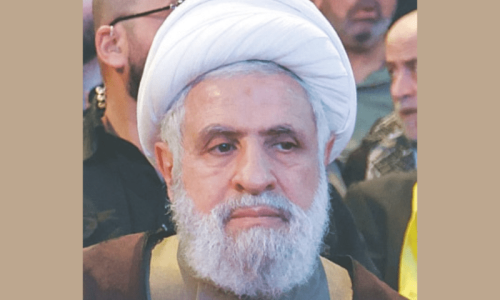
Meanwhile, in his first speech as Hezbollah’s leader, Sheikh Naim Qassem has said his group would agree to a ceasefire with Israel under acceptable terms, but added that a viable deal has yet to be presented.
Lebanon’s Prime Minister Najib Mikati also said he was striving for a ceasefire in the Israel-Hezbollah war within days.
New Hezbollah chief says open to ceasefire ‘under acceptable terms’
“We are doing our best… to have a ceasefire within the coming hours or days,” Mikati said during a televised interview with Lebanese broadcaster Al-Jadeed, adding that he was “cautiously optimistic”.
Baalbek mayor Mustafa al-Shall confirmed strikes hit the city and its surroundings, while state media said “enemy warplanes launched a series of strikes on the Asira area of the city of Baalbek” and in a nearby town.
Earlier on Wednesday, residents rushed out of their homes after the Israeli army ordered Lebanon’s biggest eastern city and its outskirts evacuated for the first time in more than a month of hostilities.
The Israeli army urged residents of Baalbek and surrounding villages to leave immediately, warning it was preparing attacks on Hezbollah targets.
The main roads out of the city were jammed with vehicles as civilians fled in panic.
Civil defence vehicles drove around the city urging everyone to leave immediately over loudspeaker. Mosques and churches delivered the same message over their loudspeakers. The city was almost empty about an hour after the evacuation warning.
US mediation
A person briefed on the talks and a senior diplomat working on Lebanon told Reuters the two-month truce would be used to finalise full implementation of United Nations Security Council Resolution 1701, adopted in 2006 to keep southern Lebanon free of arms outside state control.
A US official said White House officials Brett McGurk and Amos Hochstein will visit Israel on Thursday to engage on a range of issues “including Gaza, Lebanon, Iran and broader regional matters”.
Resolution 1701 has been the cornerstone of talks to end the last year of fighting between Israel and Hezbollah, which erupted in parallel with the war in Gaza and has dramatically escalated over the last five weeks.
“We’d like to reiterate that we seek a diplomatic resolution that fully implements 1701 and gets both Israeli and Lebanese citizens back to their homes on both sides of the border,” said Sama Habib, spokesperson at the U.S. embassy in Beirut, when asked about the reported proposal.
The two sources told Reuters that the 60-day truce has replaced a proposal last month by the United States and other countries that envisioned a ceasefire for 21 days as a prelude to 1701 coming into full force.
Both, however, cautioned that the deal could still fall through.
Top US officials, including CIA Director William Burns and envoys Brett McGurk and Amos Hochstein, will visit Egypt and Israel on Thursday, the White House confirmed, as Washington seeks to de-escalate tensions in the region.
CENTCOM’s commander, US Army General Erik Kurilla, also is in the region and will visit Israel as part of the American effort to discuss Iran, Lebanon and the release of prisoners in Gaza, White House spokesperson Karine Jean-Pierre told reporters on Wednesday.
Hezbollah ‘will accept ceasefire’
Qassem, who was named Hezbollah secretary-general on Tuesday, did not explicitly link a Lebanon ceasefire to an end to fighting in Gaza, a position previously held by the group.
“If the Israelis decide that they want to stop the aggression, we say we accept, but under the conditions that we see as appropriate and suitable,” Qassem said in a pre-recorded speech.
But Hezbollah “will not beg for a ceasefire”, he added, noting that political efforts to secure a deal have yet to yield results. “No project has been proposed that Israel agrees to and that we can discuss,” he said.
“Get out of our land to reduce your losses. If you stay, you will pay more than you have ever paid in your life,” Qassem said, adding that Hezbollah could sustain fighting “for days, weeks and months”.
He acknowledged that Israel’s killing of Nasrallah and other senior Hezbollah figures dealt the group a “painful” blow.
But he said Hezbollah “has started to recover by filling the gaps, appointing alternative leaders and commencing work to organise everything”.
Qassem also pledged to uphold the war strategy laid down by his predecessor.
Published in Dawn, October 31st, 2024