• CM Maryam calls for joint efforts with Indian Punjab to combat crisis
• 11 areas identified as smog hotspots; ‘green ring’ planned around city to curb emissions
• Restrictions imposed on barbecues, marriage halls, commercial generators
• Experts criticise provincial govt’s measures as ‘insufficient, poorly planned’
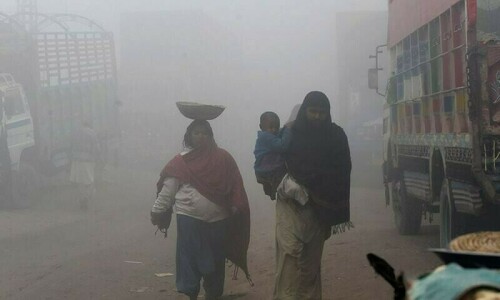
LAHORE: The Punjab government imposed a “green lockdown” in designated smog hotspots across Lahore on Wednesday, imposing restrictions on barbecue joints, motorcycle-rickshaws and marriage halls — measures described as insufficient and poorly planned by air quality experts.
The government has announced the plan in an effort to control rising pollution levels in the city, which continues to rank among the world’s most polluted cities.
On Wednesday, the city’s Air Quality Index (AQI) peaked at 588 at 3am, with levels varying across different areas. The lowest AQI recorded was below 200 from 5pm to 6pm, although this still exceeded international standards for healthy air. By 8pm, the reading was 177, a marked improvement compared to the previous two days.
Punjab’s senior minister Marriyum Aurangzeb, speaking in the Punjab Assembly, announced that 11 areas in Lahore had been identified as smog hotspots, with Shimla Hill being the most affected. She confirmed that the “green lockdown” would take effect from Thursday (today).
Earlier, the director general of the Punjab Environmental Protection Agency, Dr Imran Hamid Sheikh, issued the green lockdown notification. Pollution hotspots include major roads such as Davis Road, Egerton Road, Durand Road, Kashmir Road, Abbott Road, starting from Shimla Hill to Gulistan Cinema, Empress Road, starting from Shimla Hill to Railway Headquarters, and Queen Mary Road, starting from Durand Road to Allama Iqbal Road.
Under the green lockdown, all construction activities within a one-kilometre radius of Shimla Hill are banned. The use of commercial generators and Qingqi motorcycle-rickshaws is restricted, while open barbecue activities are prohibited after 8pm.
Similarly, food outlets using charcoal, coal or wood without proper emission control systems are required to cease operations. Marquees and marriage halls must close by 10pm, and only wet sweeping will be done by the Lahore Waste Management Company (LWMC) to reduce dust. Moreover, encroachments will be removed to ensure smooth traffic flow, heavy transport vehicles will also face restrictions, and half of office employees will work from home.
Ms Aurangzeb said the government plans to establish a “green ring” around the city using modern technology as part of the Lahore Green Master Plan. This initiative will create a “wall of trees” to reduce carbon emissions and increase oxygen levels.
She said every tree would be geo-tagged and afforestation in industrial areas will be intensified. Collaboration with industries will be prioritised to expand tree plantations, with educational institutions and students participating in a “Green Force” during the three-month smog season.
The government was also cracking down on environmental violations, she said, adding that two factories were sealed and fines totalling Rs 200,000 were imposed.
Besides, three brick kilns and four plastic melting plants were demolished and several food outlets in Model Town sealed due to excessive smoke emissions.
Trolleys carrying sand and soil are now required to use covers to reduce dust on the roads, while 296 vehicles were fined a total amount of Rs592,000 and 102 vehicles were impounded.
To further reduce pollution, the introduction of 30 electric buses and e-bikes in Lahore has been announced. The Punjab Safe Cities Authority is also issuing daily e-challans to vehicles emitting excessive smoke and taking action against individuals involved in waste burning.
However, the Pakistan Air Quality Experts’ Group, comprising leading air quality experts, researchers, doctors and scientists, has criticised the measures as insufficient and poorly planned, arguing they are unlikely to have a measurable impact on reducing air pollution.
Maryam calls for joint efforts with Indian Punjab
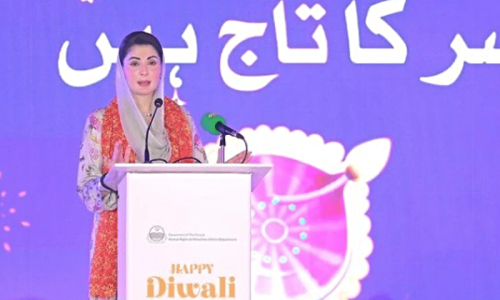
Meanwhile, Punjab Chief Minister Maryam Nawaz Sharif has expressed her desire for collaboration with Indian Punjab to combat a common enemy — smog — emphasising that the issue is humanitarian rather than political.
“Smog is not a political matter but a human challenge. I have previously called for climate diplomacy with India, and I am considering writing to the chief minister of Indian Punjab, Bhagwant Mann, to seek joint efforts to combat smog,” Ms Sharif said during a Diwali event in Lahore on Wednesday.
She stressed that both countries must unite to effectively address the smog crisis, as “winds do not recognise borders”. She added: “Unless both Punjabs unite, we will not be able to effectively combat smog.”
Earlier, Maryam Nawaz called for climate diplomacy with India, citing the impact of stubble burning in Indian Punjab on Pakistani air quality due to the wind patterns.
The city administration also previously warned that polluted air from Amritsar, New Delhi and Chandigarh was moving towards Lahore at a speed of 7km per hour, contributing to the city’s worsening smog problem.
Minority Card
During the Diwali celebrations, Chief Minister Maryam Nawaz announced the introduction of the “Minority Card” initiative to provide financial assistance to Pakistan’s minority communities. The programme, set to launch on Dec 20, will see Rs10,500 provided every three months to underprivileged minority families.
She also revealed plans for a Minority Virtual Police Station to address concerns more efficiently. “When we witness injustice or oppression against minorities, we feel deeply ashamed and distressed,” she said.
She directed police to provide immediate security where members of any minority community face the threat of mob violence. “No majority group has the right to cause undue harm or hardship to any member of a minority,” she said.
The chief minister also announced the upcoming “Himmat Card” for differently abled members of minority communities.
Published in Dawn, October 31st, 2024