Govt declares ‘smog calamity’ across Punjab


• Bans all polluting activities, deploys relief commissioners for mitigation
• People flout ‘green lockdown’ on first day; no action against encroachments, parking
• Children with medical conditions to be placed on three-month compulsory leave
LAHORE: The Punjab government declared smog a calamity on Thursday, as the provincial administration notified a host of measures, such as vacations for differently-abled children and a ban on all activities “causing or leading to smog formation” to improve the hazardous air quality across the province, particularly in Lahore.
A day earlier, the provincial government imposed a green lockdown in several areas of Lahore it considered ‘smog hotspots’, but enforcement remained lax at best on the first day. The Provincial Disaster Management Authority (PDMA) has now declared smog a calamity under Section 3 of the Punjab National Calamities (Prevention and Relief) Act, 1958.
This law allows the government to “provide for the maintenance and restoration of order in areas affected by certain calamities and for the prevention and control of and relief against such calamities”.
Section 3 of this act reads, “Whenever the province or any part thereof is affected or threatened by flood, famine, locust or any other pest, hailstorm, fire, epidemic or any other calamity which, in the opinion of government warrants action under this act, [the] government may, by [a] notification, declare the whole or any part of the province, as the case may be, as calamity-affected area.”
Section 3-A allows the government to appoint relief commissioners.
According to the notification, deputy commissioners were delegated powers of the relief commissioner to take all necessary measures to control and mitigate smog. The notification listed a number of restrictions to curb smog, for instance, on the sale and use of “sub-standard fuel”.
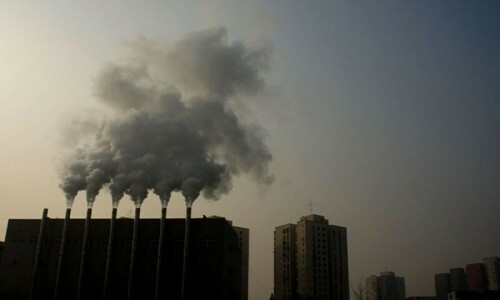
It also banned the burning of crop residue, solid waste, tyres, rubber and plastics, as well as vehicles emitting “visible smoke and pollutants falling into inadmissible limits”. It also banned industries working without emission control systems, saying they contributed to air pollution.
The government also imposed a ban on all stone crushers operating without wet scrubbers. All types of encroachments and any parking that caused hindrance in the smooth flow of traffic on public roads, including footpaths, was also banned. Similarly, all activities that would generate “fugitive dust” would be banned.
The green lockdown was imposed by the government in so-called hotspots on Wednesday, but on Thursday, Lahore remained the second-most polluted city in the world with a 201 air quality index (AQI) score, giving Lahoris hardly any space to breathe. By 10pm, the AQI was 254 and PM2.5 concentration was 35.7 times the WHO annual air quality guideline value.

Green lockdown
Traffic, however, was impacted across the city as barriers were placed on various roads due to the lockdown, but rampant violations were still reported. Despite restrictions, rickshaws continued to ply on Allama Iqbal Road and Empress Road with even government agencies flouting the guidelines.
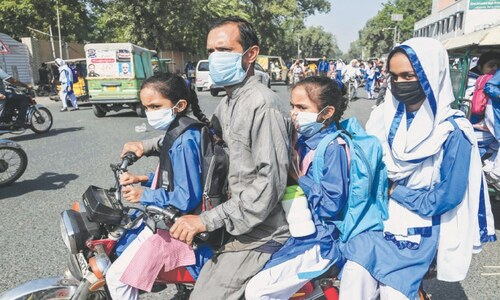
Lahore Waste Management Company (LWMC) employees swept the roads and streets without water and there were no measures to control school and college traffic on Durand Road, either. Similarly, most people did not wear masks and there was no action against encroachments and parking in the locked-down areas.
Under the green lockdown imposed on Wednesday, marquees and marriage halls must shut down by 10pm, and only wet sweeping will be done by the LWMC to reduce dust. Moreover, encroachments will be removed to ensure smooth traffic flow, heavy transport vehicles will also face restrictions, and half of office employees will work from home.
The lockdown targeted “pollution hotspots” such as Davis Road, Egerton Road, Durand Road, Kashmir Road, Abbott Road (from Shimla Hill to Gulistan Cinema), Empress Road (from Shimla Hill to Railway Headquarters), and Queen Mary Road, (from Durand Road to Allama Iqbal Road).
Moreover, all construction activities within a one-kilometre radius of Shimla Hill have been banned. The use of commercial generators and rickshaws is also restricted, while open barbecue activities are prohibited after 8pm.
Similarly, food outlets using charcoal, coal or wood without proper emission control systems are required to cease operations.
PDMA Director General Irfan Ali Kathia ordered the provincial administration to ensure the implementation of the government’s measures to prevent smog.
He vowed that a case would be registered against people who burnt crop residue.
“People should support the government in the war against environmental pollution,” the DG said, adding that a smog emergency was in place and the government would strictly deal with its violators.
Special children get compulsory leave
Meanwhile, the Environmental Protection Agency (EPA) ordered all schools of special education in Lahore to send their students, who were suffering from medical conditions caused by air pollution, on a three-month compulsory leave from Friday.
EPA Director General Dr Imran Hamid Sheikh issued the order stating that the schools, both public and private, should send “those students on compulsory leave who are suffering from diseases which get triggered by poor air quality”. Such medical conditions include asthma, tuberculosis, flu, pulmonary problems etc. The decision will take effect from November 1 (Friday) till Jan 31, 2025.
Separately, Punjab Senior Minister Marriyum Aurangzeb, in a statement, said the government was taking actions to prevent smog.
Without giving details, the minister said nine kilns and four industrial units were demolished and the government was monitoring sand trolley filling on the Ravi riverbed. Besides, surveillance in areas, like Katar Bund Road, was also being conducted, the statement added.
The minister appealed to the public to cooperate with the authorities over the lockdown and report any emissions to ‘1373’ helpline for action.
The minister claimed a shift in eastern winds led to a significant change in Lahore’s air pollution index. The government claimed the altered wind direction and speed had placed Lahore fourth with 168 AQI, on the global air pollution index. Delhi was at the top with 191, followed by Beijing with 186.
Published in Dawn, November 1st, 2024