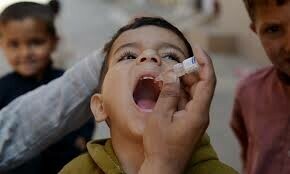
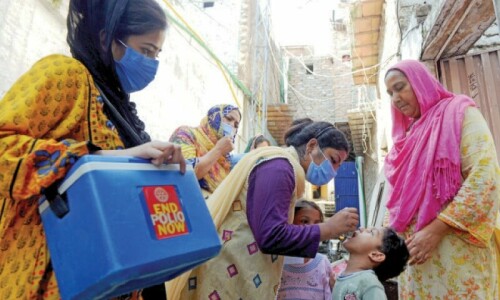
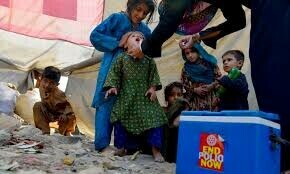
Polio refusals: Balochistan children pay the price for ‘old habits’


QUETTA: They say only bad news from Balochistan makes the headlines; mostly it’s about armed attacks and the loss of life in incidents of terrorism. But today, the province finds itself at the centre of a spiralling polio crisis, with cases witnessing a surge over the past several months.
With rising cases come vaccination drives, but many parents still consider immunisation “unnecessary”.
Jalaluddin, a father of six, is one of those people, and his two-year-old son is one of those stricken by the disease.
His home in Quetta’s Salehabad area is as simple as his own nature. Jalaluddin has apparently been frequently approached by the media ever since his son Jawad was afflicted by polio, which is why he seems fed up with journalists and their questions.
After repeated requests, he agrees to speak to Dawn, yet, he seems to be in a hurry. He says the water pump in his home has malfunctioned and he is eager to fix it so the household’s water supply remains uninterrupted.
Even though his young son has been afflicted by the poliovirus, Jalaluddin still acts like everything will be alright
I have to ask my questions as quickly as possible. During our conversation, he tries to portray as if everything is alright, seemingly unaware of the severity of the problem that faces his young child.
“Thank God, he is able to stand on his feet,” he says of his son.
Soon after the two-year-old contracted the poliovirus in mid-October, Jalaluddin started consulting local clerics, who gave him a talisman and prayed for the young child, but to no avail. One of them also told him the boy had a stroke.
Jalaluddin then saw a doctor, who informed him that his son had been actually afflicted by the poliovirus.
Growing up in Balochistan, where suspicion of anything to do with the state is a norm, it was not a big deal for Jalaluddin to keep vaccinators at bay by hiding them whenever polio teams came to visit.
Although things have improved in the region, thanks to awareness campaigns launched by the government and NGOs, cases still continue to emerge from the province, mostly because old habits die hard.
Jalaluddin, who is a shopkeeper, claimed he had all his children, including Jawad, inoculated. However, interviews with those who know the family reveal that the afflicted child had only received the drops once, that too soon after his birth.
Jawad is not alone; so far, 22 cases have been reported from across the province this year. Most of the cases have been reported from the seven districts bordering Afghanistan.
Afghanistan and Pakistan are the only two countries left that are still not rid of the scourge of polio.
“This is because of the virus flow [from Afghanistan] that Balochistan has so many cases,” says Abdul Hadi Khan, a communications officer associated with the anti-polio drive. “That is why cases are increasing in Balochistan.”
It is Hadi who introduces us to Jalaluddin. While talking about the afflicted child, the officer says poliovirus attacks children whose immune system is not strong enough, which is why they are given the polio drops.
“There are grey houses [which] are refusal cases,” he says, talking about parents who refuse to allow their children to get polio drops. “Some children are not present when the polio team visits, while others claim they have gone to visit their relatives. We try to achieve our target; we try to convince the parents who refuse to give polio drops to their children in any way possible.”
In most cases, it has been observed that young boys are affected by the poliovirus.
According to Hadi, this could be because the boys go out to play in contaminated areas, where the virus could be present, while girls are hardly allowed to venture out.
As we leave, Jalaluddin goes to see to his water pump. He may well be able to fix it, as he does not seem like the negligent type. But his reluctance to vaccinate his son may cost the young one dearly, for the rest of this life.
Published in Dawn, November 4th, 2024