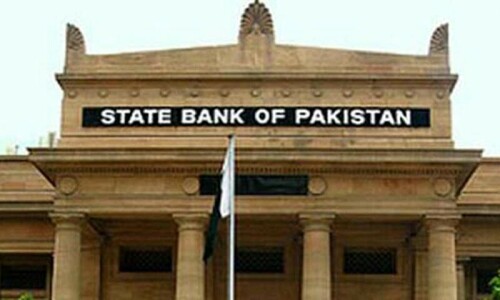
KARACHI: Businessmen on Monday appeared unsatisfied with the 250 basis points cut in interest rate by the State Bank of Pakistan (SBP), terming the move not in line with receding inflation and urged the policy rate either should have been lowered by 500-700bps or be brought down to a single digit.
In contrast, representative bodies of foreign multinational companies offer a moderate view. For example, the Overseas Investors Chamber of Commerce and Industry (OICCI) Chief Executive and Secretary General M. Abdul Aleem said the policy rate reduction to 15pc is better than anticipated. It reflects the improving trend on inflation and other fundamentals, which are bound to give confidence to the market.
“We anticipate that with the ongoing strict watch on power sector charges and expected stability in international fuel pricing, this downward trend will continue for the next few months,” he said.
The government has taken some bold measures recently on the economic front, which need to be supplemented by strict measures to arrest tax revenue leakage in many sectors, including the retail and wholesale trade and the services sector, to boost the economy further, Mr Aleem said.
OICCI and PBC welcome the ‘balanced approach’
The OICCI executive said the government needs to control its expenditure, urgently implement its promised disposal of state-owned enterprises, and bring stability and consistency in policy and implementation. The country has the potential to deliver much better results than what is being offered to accelerate economic activity, boost employment and motivate local and foreign investors.
Pakistan Business Council (PBC) Chief Executive Officer Ehsan Malik said the SBP’s Monetary Policy Committee (MPC) decided to maintain a relatively tight policy to sustain the downward trend in inflation and support the hard-won macroeconomic stability.
He said the MPC took cognisance of multiple risks, such as escalation in the Middle East conflict, recurrence of food inflation pressures, ad hoc adjustments in administered energy tariffs, and implementation of further taxation measures to meet revenue shortfalls. Nevertheless, a 250bps reduction is the highest of the four consecutive cuts, and 50bps higher than the median expectation by market analysts.
Further reduction, Mr Ehsan believed, would be contingent on maintaining the downward trend in inflation, a near-balanced current account, stable exchange rates, progress on taxation measures, and control of government expenditure. He added that the SBP could selectively deploy non-rate measures to ease controls over consumer credit.
Karachi Chamber of Commerce and Industry (KCCI) President Muhammad Jawed Bilwani said the business community had anticipated a more substantial reduction of at least 500bps, but the latest cut is inadequate and does not align with the declining trend in inflation, which has now fallen to a single digit.
“The 15pc policy rate remains too high. It is essential for the rate to be reduced more aggressively, ideally by 500-700bps in line with many other countries in the region and worldwide,” he said.
“The business community wants to see interest rates dropping to single digits as this will encourage borrowing, promote business expansion by lowering the cost of doing business, stimulate economic growth and alleviate the financial burden on businesses and consumers,” he demanded.
A tight monetary policy implemented by the SBP had led to exceptionally high borrowing costs, causing substantial harm to the economy, particularly affecting the manufacturing sector. Bilwani said a significant cut has become necessary.
The KCCI chief noted that inflation has plunged to a single digit due to the government’s administrative measures, improved agriculture production and descending world oil prices instead of the SBP’s tight monetary policy.
Korangi Association of Trade and Industry President Junaid Naqi emphasised the need to reduce the rate to single digits for sustainable economic growth. The current high interest rate has been counterproductive, thus slowing down economic activity and limiting industrial capital availability.
To address the concerns about the potential for increased imports following interest rate cuts, which could pressure the currency and trade balance, he said the government should take proactive steps to control imports.
Published in Dawn, November 5th, 2024