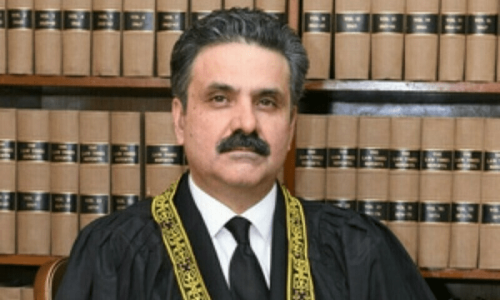
ISLAMABAD: As a part of his commitment to strengthening service delivery and broadening access to justice, Chief Justice of Pakistan (CJP) Yahya Afridi on Thursday convened a meeting to stress the importance of building IT capacity and conducting a thorough business process analysis of the judicial system.
During the session, participants engaged in constructive discussions and observed that these initiatives were anticipated to address existing bottlenecks, ultimately making the justice system more accessible, transparent and efficient.
All representatives assured their full commitment to supporting and advancing these reform efforts. The meeting resolved that focal persons nominated by the participating universities will coordinate closely with the Supreme Court’s team to carry forward this transformative agenda.
At the outset of the meeting, the CJP welcomed the participants and highlighted the challenges facing Pakistan’s justice system.
He underscored that these reforms would encompass every tier of the judiciary, beginning at the Supreme Court and extending to lower courts.
Emphasising a collaborative approach, the CJP stated that feedback from all stakeholders — judges, lawyers, litigants, and citizens — would be central to developing a responsive and effective system.
The CJP further acknowledged the invaluable role of academia in this transformative process, inviting universities to contribute their expertise to enhance judicial efficiency, transparency and accessibility.
Registrar of the Supreme Court Mohammad Saleem Khan addressed the meeting on the pressing need for comprehensive reforms within the justice sector, setting a clear agenda for enhanced service delivery.
Development expert Sher Shah outlined the CJP’s reform vision and presented short-term foundational plans as essential stepping stones towards medium-term and long-term improvements.
Hamayoon Zafar detailed the judiciary’s digital transformation roadmap, highlighting short-, medium- and long-term objectives to modernise the system through technology.
The meeting was attended by academics from Pakistan’s leading universities and prominent development experts and advocates, including Dr Ali Cheema, Vice Chancellor of Lahore University of Management Sciences; Dr Aftab, Rector, Fast University; Prof Dr Fazal Khalid, Rector, Ghulam Ishaq Khan Institute of Engineering Sciences and Technology; Dr Rizwan Riaz, Pro-Rector, National University of Sciences and Technology; and, Rauf Ata, President of Supreme Court Bar Association, to lay the groundwork for comprehensive justice sector reforms.
Published in Dawn, November 15th, 2024