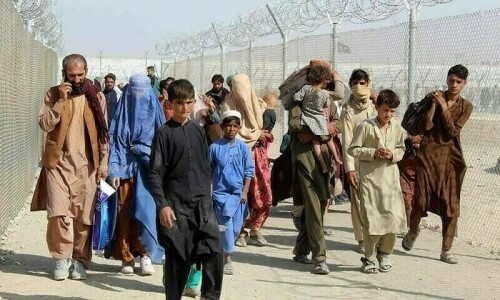
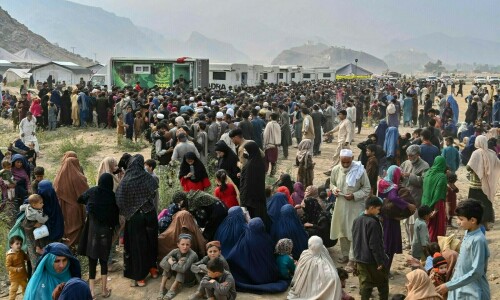
Pakistan on Tuesday suggested an international multilateral stakeholders’ conference aimed at addressing the challenges related to the voluntary repatriation and third-country resettlement of Afghan refugees.
The idea was floated by Muhammad Abbas Khan, chief commissioner for Afghan refugees (CCAR) at the Ministry of States and Frontier Regions (SAFRON), at an Islamabad seminar.
He said the main objective of the conference should be to encourage Western countries to increase their quotas and expedite the process for admitting Afghan applicants into their countries from Pakistan.
The CCAR was speaking at a seminar titled “Challenges and Opportunities in Repatriation and Resettlement of Afghan Refugees” organised by the Institute of Regional Studies (IRS).
The commissioner underscored the importance of international burden-sharing, urging global stakeholders to enhance resettlement opportunities for Afghan citizens on Pakistani soil.
He shared that there were around 600,000 Afghan resettlement applicants registered with the United Nations High Commissioner for Refugees (UNHCR) but that the organisation’s quota for resettlement applications for the year was only 8,000. This, he maintained, was very unrealistic.
The CCAR highlighted the immense challenges associated with the repatriation of Afghan refugees.
Forced displacement, he noted, was a cross-cutting issue, encompassing social, political, economic and security dimensions and increasingly intersecting with climate change.
He added that Afghanistan’s fragile absorption capacity and limited infrastructure made reintegration of the returning Afghan citizens a challenging proposition.
He further stressed the importance of addressing psychosocial adjustment challenges and called for efforts to create a secure and investment-friendly environment in Afghanistan to support sustainable reintegration.
The CCAR shared that Pakistan had repatriated over four million Afghan refugees since 2002 and argued that most of the refugee population of 2024 was born and raised in Pakistan and was dependent on Pakistan for economic, health and educational services.
He further stated that Afghanistan’s capacity to absorb large numbers of refugees was highly limited. Despite these hurdles, the commissioner expressed hope that the refugees, 70 per cent of whom were under the age of 30, had the potential to contribute significantly to Afghanistan’s reconstruction.
Highlighting Pakistan’s contributions to hosting millions of Afghan refugees over the decades, the CCAR underscored the peculiar characteristics of Pakistan’s Afghan refugee situation.
He called for a balanced approach towards the subject of Afghan refugees grounded in up-to-date and reliable facts and figures rather than misplaced perceptions.
He termed the data about Afghan refugees as misleading, unreliable and outdated and also called for a review of policy towards Afghan refugees.
“The reality lies somewhere between perceptions and data,” he remarked.
Citizenship to Afghans born in Pakistan
The CCAR said Afghanistan, in a tripartite agreement with Pakistan and the UNHCR in 2003, had opposed the Pakistani nationality for Afghan children born in the country.
He said Afghanistan was of the view that any such decision would create friction within Afghan families as parents would have Proof of Registration cards and their children would hold Pakistani citizenship.
“Afghans had clearly stated that they want to preserve their identity,” he said when he was asked why Pakistan did not grant citizenship to Afghans born in the country.
He said a tripartite meeting with the Afghan interim government and the UNHCR would be held soon to discuss issues related to refugees.
Repatriation of illegal Afghans
The Afghan commissioner said the repatriation process of illegal Afghans had gone smoothly and successfully and over 600,000 had returned since the process began in November 2023.
He said any decision about the repatriation would be taken with all stakeholders, including Afghanistan and the UNHCR.
IRS President Ambassador Jauhar Saleem called for a coordinated international response in consultation with the federal government to streamline the resettlement process and provide adequate support for Afghan refugees transitioning to new lives in Western countries.
The seminar concluded with recommendations, including strengthening voluntary repatriation programmes, fostering global collaboration and investing in host communities. Participants also called for efforts to ensure Afghanistan became more secure and investment-friendly, enabling it to effectively absorb returning refugees.