• Rs50,000 subsidy for electric bikes, Rs200,000 for rickshaws announced
• PAMA raises concerns over NEV policy’s impact on local auto industry
ISLAMABAD: Amid reservations from key stakeholders, the government on Wednesday announced the New Energy Vehicle (NEV) policy aimed at transitioning 30 per cent of all new vehicles — imported and locally manufactured — in Pakistan to electric power by 2030.
Minister for Industries and Production Rana Tanveer Hussain unveiled the measures at a news conference, claiming that all stakeholders had been consulted in the policy-making process.
However, soon after his address, the Pakistan Automotive Manufacturers Association (PAMA) issued a statement expressing strong reservations about the potential impact of the new policy on the local auto industry.
The new policy includes electric vehicles (EVs) and other emerging energy sources like hydrogen. As part of the policy, the minister said, the government introduced subsidies of Rs50,000 for electric motorcycles and Rs200,000 for three-wheelers (rickshaws), with a total allocation of Rs4 billion. These subsidies will be distributed through auctions. So far, two companies have been granted licences, and 31 more applications are under review.
Mr Hussain said the International Monetary Fund (IMF) had no objections to the tax exemptions and subsidies provided under the NEV policy, adding that the transition to EVs would significantly reduce Pakistan’s dependency on costly imported petroleum products and help mitigate environmental pollution.
The policy also incorporates a reduction in the policy rate from 22 per cent to 15pc, with financing available at a 3pc Kibor (Karachi Interbank Offered Rate), with the government covering the financial cost. Consumers will pay monthly installments of around Rs9,000 over two years, an amount lower than their projected fuel savings.
A Credit Loss Guarantee managed by the Finance Division ensures no financial burden on the Ministry of Industries or the consumers.
Additional initiatives include offering free electric bikes or scooters to 120 high-achieving students and reducing duties on EV components to encourage local manufacturing. The government is also set to establish a New Energy Fund and a New Energy Vehicle Centre to support these measures.
Currently, the key global EV manufacturer, BYD Group of China, has obtained a manufacturing licence in Pakistan, while Dewan Motors is also set to launch its EVs under the completely knocked down (CKD) licence.
PAMA’s concerns
The PAMA raised several concerns regarding the NEV policy in a letter to the Engineering Development Board (EDB), warning that the import of completely built units (CBUs) at a reduced duty structure compared to CKDs could harm the local industry.
PAMA Director General Abdul Waheed Khan argued that CBU imports should only be allowed to companies with a minimum level of local manufacturing facilities, as per SRO 656, to avoid creating a junkyard and leaving customers without after-sales support.
The PAMA also recommended that the current policy for hybrid electric vehicles (HEVs) and plug-in hybrid vehicles (PHEVs) continue until 2030, and if any further incentives are granted to PHEVs, the same should be extended to HEVs.
It suggested that duties and incentives for NEVs be aligned with those for other vehicles starting from the third year. PAMA called for mandating CBU importers to establish local manufacturing facilities within a set timeframe to ensure long-term growth for Pakistan’s auto industry.
It further recommended aligning duties and incentives for NEVs with those for internal combustion engine (ICE) vehicles that use petrol, diesel, or CNG, with incentives phased out by 2030. The association also suggested including renewable energy vehicles, such as biogas-fueled cars, in the NEV policy and ensuring policy continuity for HEVs and PHEVs.
Promotion of EVs
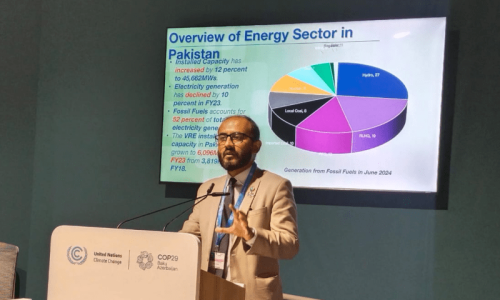
Meanwhile, Minister for Communications and Privatisation Abdul Aleem Khan, who is currently at COP29, said work has already begun to promote EVs in Pakistan.
Speaking at the Ministerial Roundtable Session, he said projects such as Green Urban Transport, Electric Vehicles and Renewable Energy were essential to meet future challenges posed by population growth in major cities and increasing air pollution.
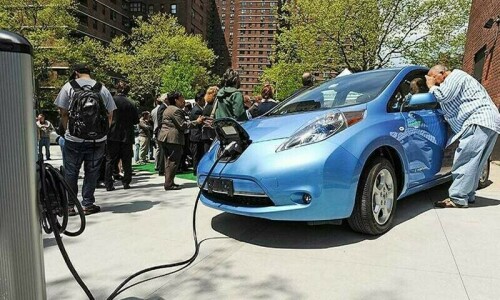
Mr Khan said efforts are under way to establish 3,000 charging stations by 2030, a key step in revolutionising Pakistan’s auto sector. Power rates at charging stations will be lower, making EVs more affordable for consumers, he added.
The minister said the first fleet of biomethane hybrid buses in Karachi would save 100pc of fuel and that there is an option for a public-private partnership for the National Green Transport Project.
Published in Dawn, November 21st, 2024