• Pakistan’s lead negotiator terms new draft agreement ‘disappointing’
• G-77 demands ‘demystification’ of finance
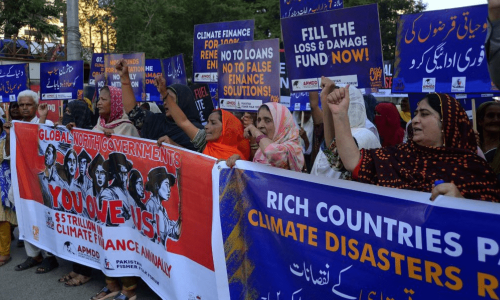
• Activists call on developed world to cough up money it owes to developing states

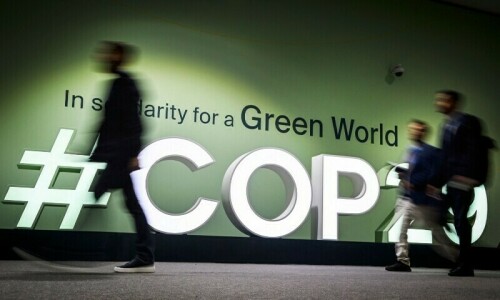
THE so-called climate finance conference at COP29 failed to make any headway on Thursday, as a new draft resolution for the new collective quantified goal (NCQG) — termed disappointing by Pakistan’s lead negotiator — failed to bridge the chasm between the developed and developing countries on how to scale up finance to counter climate change.
Soon after its delayed release in the early morning, the draft came under fire by developing countries, including Pakistan, who were visibly upset with the developed countries for not even agreeing to the quantum of the finance despite almost two weeks into the negotiations. Instead of the number, which according to them should be $1.3 trillion, the document only mentions a placeholder ‘X’.
Another disagreement which is stalling the talks is the contributing base. Developing countries, including China and India, want wealthier nations to fulfil their obligations and scale up climate finance under the Paris Agreement signed in 2015.
An official of the G-77 delegation said one of their demands right now “is to demystify” the finance package. There has been no definition of the quality (public vs private finance) and the quantity (the total amount) of climate finance and we need that, the official added on the condition of anonymity.
Arif Goheer, who represents Pakistan at the NCQG talks, said the document was “disappointing”.
The draft resolution also came under fire in the plenary, as most delegates, including Aisha Moriani who was representing Pakistan at the high-level meeting, expressed their displeasure with the inaction on pressing climate issues.
UN chief Antonio Guterres, in his address, meanwhile, urged the countries to find common ground. “We need a major push to get discussions over the finishing line,” he said in his address. But in the current form, it seems there is no “common ground” to agree on.
Not only there are differences regarding the quantum of money, but the countries also differ on transparency and variety of finance. The mobilisation of private finance, which is proposed by the wealthy countries, is not endorsed by the developing countries who want them to mobilise public finance to avoid more debt traps.
“There’s two options: one that could unlock trillions in finance or one allowing developed countries to shirk their responsibilities onto the private sector and developing countries,” Jasper Inventor, who heads the COP29 delegation for Greenpeace International, said.
Besides the contributors’ base, there are also disagreements about the recipients. The developing countries also say that they will not commit to new climate targets (nationally determined contributions) without a prior agreement on money.
Sustainable Development Policy Institute Executive Director Abid Sulehri said it seemed the developed countries did not want to take historical responsibility for emissions. “I don’t think with this sort of lose-lose approach we can think of a sustainable future. The wealthy countries needed to cough up more funds…”
Harjeet Singh, global engagement director for the Fossil Fuel Non-Proliferation Treaty Initiative, said: “The revised draft text “recognises the need to prioritise grants but remains silent” on the scale of the new finance goal.
“We must focus not only on the vast sums required — trillions, as acknowledged — but on ensuring these funds are provided as grants, not loans, to shield nations most impacted by climate change from further financial burdens,” he said, adding that true support for a “just transition away from fossil fuels must include robust public finance, not hollow words”.
According to Jamie Williams of Islamic Relief Worldwide, people dying from the “climate emergency can’t survive on empty words, they need clear financial commitments from the countries that caused the crisis”. “The text recognises that trillions of dollars are needed but fails to commit any specific amount,” he said while also criticising the shift towards private investments over public finance.
As the stalemate on negotiations continues, there is a flurry of activity at the venue, with press conferences by the major negotiating blocks. A new draft agreement will likely be released in the afternoon and the delegates will meet again to iron out the differences.
But there is no number from the wealthy countries on the scale of finance, a fact pointed out by most civil society organisations as well as the governments. According to Mr Sulehri, there is only a good outcome when “everybody leaves the room equally unhappy”. And there are speculations the conference will overrun its scheduled timeframe, since an agreement on Friday is unlikely.
This story was produced as part of the 2024 Climate Change Media Partnership, a journalism fellowship organised by Internews’ Earth Journalism Network and the Stanley Center for Peace and Security.
Published in Dawn, November 22th, 2024