Three Muslims killed in India amid Mughal-era mosque ‘survey’


NEW DELHI: Three Muslim men were killed as protesters opposing the survey of the Mughal-era Shahi Jama Masjid in Sambhal in Uttar Pradesh clashed with the police on Sunday, The Wire reported.
It quoted local Muslims as alleging that the three men were killed in police firing.
But the administration claimed that they were killed in cross-firing between the members of the mob, which attacked the police with stones from three sides and fired bullets at them.
A senior government official claimed that the police only lobbed teargas and used plastic bullets to disperse the protestors and evacuate the survey team from the area after the crowd rained stones at them.
The three persons who were killed in the “golibari” (firing) incident were identified as Naeem, Noman and Bilal, said Moradabad divisional commissioner Aunjaneya Kumar Singh.
Hindu activists claim the 500-year-old mosque was originally a temple site
The official, according to The Wire, said that 15-20 police constables were injured in the stone-pelting, a public relations officer of the Sambhal district police chief was shot in the leg, a deputy collector’s foot was fractured and a police circle officer was hit by a shrapnel.
Fifteen persons, including two women, accused of pelting stones at the police from a rooftop, were detained during the violence, said the commissioner.
Three or four cars and a couple of motorbikes parked in the area were also torched by the protesters, said the official.
The police said they were searching for those who indulged in the stone pelting on the basis of CCTV and drone camera footage and planned to slap the stringent National Security Act (NSA) against them.
“They challenged the police and administration in a targeted way and this was not the act of an unruly mob,” said Superintendent of Police Sambhal Krishan Kumar Bishnoi, alleging that the mob wanted to disrupt the survey work in the mosque.
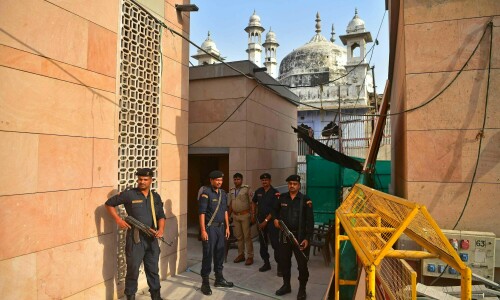
The violence broke out in lanes near the Shahi Jama Masjid when an advocate commissioner appointed by a local court was conducting the survey in the presence of the local administration and police.
The court on Nov 14 ordered a survey of the mosque after taking cognisance of an application by some Hindu activists who filed a suit claiming that the Islamic religious site, built during the time of Emperor Babur, was originally a prominent Hindu temple dedicated to the prophesied avatar of Vishnu, Kalki.
After conducting an initial hurried survey of the mosque within a few hours of the court’s orders, the survey team reached the mosque for a second round of photography and videography on the morning of Nov 24.
The survey, which started around 7:30am, went on peacefully for two hours when a crowd gathered and started raising slogans, said the commissioner.
Civil judge Aditya Singh had directed the survey of the mosque on an application filed by plaintiffs, led by pro-Hindutva lawyer Hari Shankar Jain and Hindu seer Mahant Rishiraj Giri, as part of a civil suit claiming right for access into the mosque, The Wire said.
The mosque, claimed to have been built on the directions of the first Mughal emperor Babar, is acknowledged as a “historic monument” on the official website of the Sambhal district.
The Hindu petitioners, however, claimed that the mosque was the site of an ancient temple dedicated to Kalki, the prophesised final incarnation of Vishnu.
Advocate Vishnu Shankar Jain claimed Emperor Babur partly demolished the Hari temple and tried to convert it into a mosque in 1529.
While accepting the plea of the Hindu plaintiffs to get the mosque surveyed by an advocate commissioner, the court said, “The submission of a report of the site might facilitate the court to adjudicate the suit”.
In their suit, the plaintiffs said that the mosque was a monument protected under Section 3 (3) of the Ancient Monuments Preservation Act, 1904. They claimed that they were being “denied access” to the mosque.
The plaintiffs claimed that the site was a centuries-old Hari Temple dedicated to Kalki and was being “used forcibly and unlawfully” by the Jama Masjid committee.
SP MP from Sambhal, Zia-ur-Rehman Barq, who has opposed the survey on the grounds that the mosque was protected by The Place of Worship Act, 1991, appealed for peace after the violence. He promised to raise his voice against “police brutality” during the winter session of the parliament.
Vishnu Shankar Jain, the lawyer representing the Hindu plaintiffs, said the survey work was complete and the advocate commissioner would submit report to the court.
Published in Dawn, November 25th, 2024