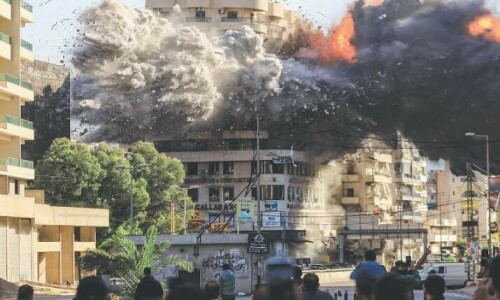
BEIRUT: Israel on Thursday admitted to carrying out an air strike in south Lebanon, violating the truce that came into force a day earlier, as Lebanon accused Tel Aviv of multiple ceasefire violations.
“The Israeli enemy violated the deal several times,” the army said, citing air strikes and attacks on Lebanese territory with “various weapons”.
Lebanon deployed troops and tanks on Thursday across the country’s south, where only the army and UN peacekeepers are to maintain a presence under the terms of the ceasefire.
A Lebanese army source said its forces were “conducting patrols and setting up checkpoints” south of the Litani River without advancing into areas where Israeli forces were still present.
BBC report reveals IDF efforts to erect ‘military divide’ across north Gaza, to separate it from rest of Palestinian territory
The Israeli military claimed it targeted a used by Hezbollah to store mid-range rockets, but Nazih Eid, mayor of Baysariyeh in south Lebanon, told AFP a strike had hit an area of his town.
“They targeted a forested area not accessible to civilians,” he said.
Earlier on Thursday, Israeli fire wounded two people in a border village, according to Lebanon’s official National News Agency.
Devastation
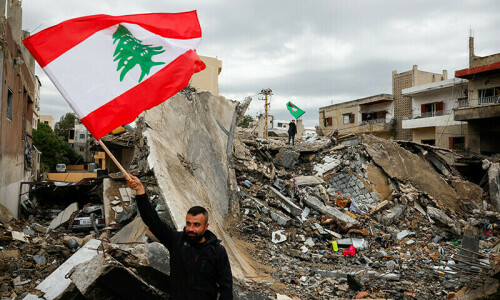
While there was joy around Lebanon that the war has ended, the country faces a long recovery.
Tens of thousands of Lebanese who fled their homes during the war have headed back to their towns and villages, only to find them devastated.
“Despite all the destruction and the sorrow, we are happy to be back,” said Umm Mohammed Bzeih, a widow who fled the southern village of Zibqin with her four children two months ago.
“I feel as if our souls have returned,” she said, visibly exhausted as she swept up the shattered glass and rubble that carpeted the floor.
In the border village of Qlayaa, residents threw rice and flowers to celebrate the arrival of Lebanese soldiers.
Meanwhile, A World Health Organisation official voiced optimism on Thursday that some of the health facilities in Lebanon shuttered during more than a year of conflict would soon be operational again, if the ceasefire holds.
“Probably some of our hospitals will take some time, but some hospitals probably will be able to restart very quickly,” Abdinasir Abubakar, WHO representative in Lebanon, told an online press conference after a damage assessment this week.
“So we are very hopeful,” he added, saying four hospitals in and around Beirut were among those that could restart quickly.
Israel dividing north Gaza
Separately, a BBC Verify report published on Thursday revealed that Israel was creating a new military dividing line in Gaza, separating the far north of the strip from the rest of the Palestinian territory.
It said that satellite images appeared to show troops in control of, and clearing, an area across the width of north Gaza. Satellite images and videos also showed that hundreds of buildings had been demolished between the Mediterranean Sea and the Israel border, mostly through controlled explosions.
Images also show Israeli troops and vehicles stationed across the new divide. Analysts said the images suggest Gaza is being split into zones.
Dr H A Hellyer, a Middle East security expert from the Rusi think tank, said the satellite images suggested Israel was preparing to block Palestinian civilians from returning to the north Gaza governorate. More than 100,000 people have already been displaced from the far north of Gaza, according to the UN.
Images appear to show two long sections of road on either end of the strip being connected by cleared land through an urban area. Buildings are being demolished between the two sections of road, with a clear pattern visible since early October.
This partition stretches about 5.6 miles (9km) across Gaza, from east to west, dividing Gaza City and the towns of Jabalia, Beit Hanoun and Beit Lahia in north Gaza.
The UN also said that “virtually no aid” has entered parts of the North Gaza governorate in 40 days on Nov 20. A spokesperson on Nov 26 said that Palestinians were “facing critical shortages of supplies and services, as well as severe overcrowding and poor hygiene conditions” due to the blockade.
Published in Dawn, November 29th, 2024