• JCP set to consider appointment of 21 judges today
• Senior puisne judge urges CJP Afridi to postpone meeting
• Urges rules to lay down criteria for selection of judges
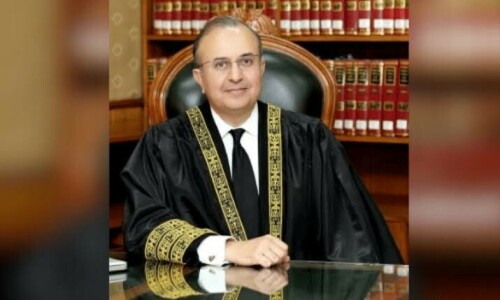
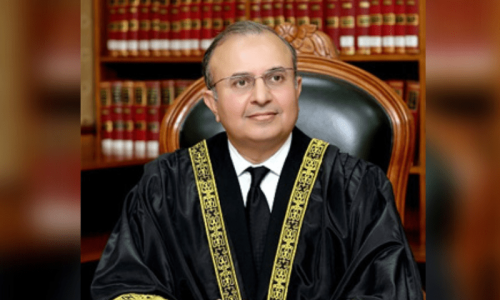
ISLAMABAD: A day before the Judicial Commission of Pakistan’s (JCP) meeting to consider appointment of additional judges to Sindh and Peshawar high courts, senior puisne judge of the Supreme Court, Justice Syed Mansoor Ali Shah, suggested postponing the session until challenges to the 26th Amendment are determined.
In a three-page letter, Justice Shah requested Chief Justice of Pakistan (CJP) Yahya Afridi to postpone the JCP meeting and convene instead a full court to fix pending challenges to the 26th Amendment for hearing. Justice Shah also suggested the JCP make rules of its procedure under Article 175A(4).
Headed by the CJP, the commission will consider 12 candidates to fill vacancies in the SHC — Suresh Kumar, Khalid Hussain Shahani, Obaid Ur Rehman Khan, Rafiq Ahmed Kalwar, Umaimah Anwar Khan, Muhammad Osman Ali Hadi, Muhammad Umar Lakhani, Mansoor Ali Ghangro, Parkash Kumar, Zeeshan Abdullah, Muhammad Zeeshan Adhi and Muhammad Jaffer Raza.
For the PHC, the JCP will consider the nomination of District and Sessions judge Kaleem Arshad, Farah Jamshed, Inamullah Khan, advocates Junaid Anwar, Syed Mudasser Ameer, Aurangzeb, Qazi Jawad Ehsanullah, Salahud Din and Sadiq Ali.
These names have been suggested by the chief justices of SHC and PHC, Muhammad Shafi Siddiqui and Ishtiaq Ibrahim, respectively.
In his Dec 4 letter, Justice Mansoor, who is also member of the JCP, highlighted that the commission was reconstituted under the 26th Amendment, whose very constitutional validity has been challenged.
Over two dozen petitions are pending before the SC and while the outcome of this challenge remains uncertain, a verdict invalidating the amendment would render any decisions taken by the JCP null and void. Such an eventuality, the letter said, could cause serious embarrassment to the institution and the individuals involved, as was witnessed following the apex court’s 2009 decision in the Sindh High Court Bar Association case, when a number of judges who had taken oath under the Provisional Constitution Order had to go home.
It will not only embarrass and weaken the institution but will also lead to a significant waste of public resources and time, the letter suggested, adding that all this could be avoided by deciding the petitions challenging the 26th amendment by the full court.
Moreover, appointments made by the JCP, whose constitutional validity and legitimacy is under question, will cast shadows over the moral authority of these appointments and generate mistrust and weaken public confidence in the judiciary, Justice Shah feared.
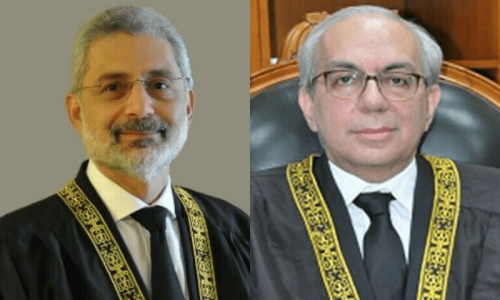
To avert such anomalies, Justice Shah recalled, Justice Munib Akhtar and he being majority members of the then three-judge committee had resolved on Oct 31, to fix the petitions challenging the amendment for hearing by a full court.
However, those petitions have not yet been fixed for hearing by the Registrar, Justice Shah regretted, adding “we never received any response”.
It is pertinent to note that Article 191A(3) bars hearing by any court other than a Constitutional Bench, but does not bar the full court from hearing any matter.
Justice Shah also pointed out a constitutional impediment to the making of these appointments by the JCP, stating that Article 175A(4) expressly mandates the commission to make its rules of procedure, “including the procedure and criteria for assessment, evaluation and fitness for appointment of judges”.
In the absence of such rules, any proceedings undertaken by the JCP for the appointment of judges would be unconstitutional, the letter claimed.
Meanwhile, the JCP notified the inclusion of PTI Chairman Barrister Gohar Ali Khan as a member of the JCP to substitute Omar Ayub Khan.
Second letter
On Thursday, Justice Mansoor wrote a separate letter to the secretary of JCP, highlighting the need for formulating rules under Article 175A(4) to provide for procedure and criteria for assessment, evaluation and fitness for the appointment of judges.
Without such a framework, the process risks lacking transparency, consistency and meritocracy, the letter said, adding that overarching policy must first define the pool of potential appointees, i.e., members of the district judiciary, practicing advocates considering their expertise in specific areas of law and advocates who bring diversity in terms of gender, region and religion.
The framework must provide essential particulars about nominees that must be documented before any name is proposed. These, inter alia, include professional work experience, reported judgements, tax paid, and other relevant antecedents that reflect their integrity, competence and commitment to the rule of law.
Justice Shah reminded that previously, he co-chaired a rule-making committee constituted by the erstwhile commission. The committee included senior puisne judges of high courts, nominated members of the Pakistan Bar Council and the Provincial and Islamabad Bar Councils as representatives of their respective bars, and the attorney general for Pakistan as the representative of the government.
Published in Dawn, December 6th, 2024