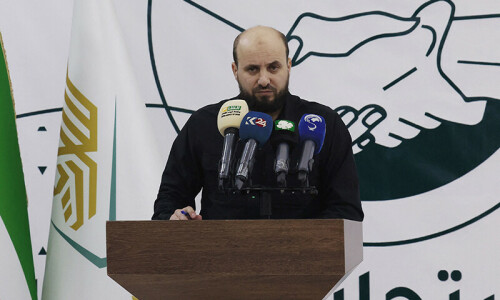
New Syria leader Mohammad al-Bashir calls for ‘stability and calm’


Syria’s new transitional prime minister Mohammad al-Bashir on Tuesday said it was time for “stability and calm” in the country, two days after longtime president Bashar al-Assad was toppled by rebels in a lightning offensive.
The rebels appointed Bashir as the transitional head of government to run the country until March 1, a statement said.
“Now it is time for this people to enjoy stability and calm,” Bashir told Qatar’s Al Jazeera television in his first interview since being appointed.
Assad fled Syria as an Islamist-led opposition alliance swept into the capital Damascus over the weekend, bringing to an end five decades of brutal rule by his clan.
A senior official told US broadcaster NBC that the ousted Syrian leader was now in Moscow.
Abu Mohammed al-Jolani, the Islamist leader who headed the rebel offensive, had previously announced talks on a transfer of power and vowed to pursue former senior officials responsible for torture and war crimes.
On Tuesday, he sought to allay fears over how Syria would be ruled, telling British broadcaster Sky News the country was “exhausted” by war and would not be heading back into one.
“Syria will be rebuilt … The country is moving towards development and reconstruction. It’s going towards stability,” he said.
“People are exhausted from war. So the country isn’t ready for another one, and it’s not going to get into another one.”
His group, Hayat Tahrir al-Sham, is rooted in Syria’s Al-Qaeda branch and is proscribed by many Western governments as a terrorist organisation, though it has sought to moderate its image.
350 Pakistanis evacuated to Lebanon for repatriation
Meanwhile, around 350 Pakistani nationals, including 245 pilgrims stranded in Syria, have so far crossed the Syria-Lebanon border for safe repatriation, the Associated Press of Pakistan reported on Tuesday.
Pakistan’s embassy in Damascus facilitated the repatriation process, APP quoted a Foreign Office press release as saying.
Deputy Head of Mission Umar Hayat accompanied the Pakistani nationals to the border, where his Beirut counterpart, Nawab Adil, received them in Lebanon.
Earlier on Tuesday, the federal cabinet was informed that 79 out of 250 Pakistani pilgrims in Syria had reached Beirut from where they would be brought back to Pakistan. Prime Minister Shehbaz Sharif said he had spoken with Lebanon PM Najib Mikati to coordinate the return of “some 500-600 Pakistanis” from Syria via Beirut.
‘Unity, inclusiveness’
US Secretary of State Antony Blinken urged all nations to support an “inclusive” political process in Syria, saying the United States would eventually recognise a government if it meets such standards.
Blinken said the future government of Syria should be “credible, inclusive and non-sectarian”.
Laying out US priorities, Blinken said the new government must “uphold clear commitments to fully respect the rights of minorities” and allow the flow of humanitarian assistance.
The United States wanted the next government to “prevent Syria from being used as a base for terrorism”, he added.
Although they no longer hold any territory in Syria, the militant Islamic State group (IS) remains active.
The Syrian Observatory for Human Rights war monitor said IS fighters killed 54 government troops after capturing them as they fled across the vast Syrian desert.
The UN envoy for Syria said the groups that forced Assad to flee must transform their “good messages” into actions on the ground.
“They have been sending messages of unity, of inclusiveness,” Geir Pedersen said. “What we need not to see is … that this is not followed up in practice in the days and the weeks ahead of us,” he added.
EU foreign policy chief Kaja Kallas warned of the risks of sectarian violence and a resurgence of extremism.
“We must avoid a repeat of the horrific scenarios in Iraq, Libya and Afghanistan,” she said.
Syria’s nearly 14-year civil war killed 500,000 people and forced half the country to flee their homes, millions of them finding refuge abroad.

Thousands missing
The fall of Assad has sparked a frantic search by families of the tens of thousands of people held in his security services’ jails and detention centres.
As they advanced towards Damascus, the rebels released thousands of detainees, but many more remain missing.
Syria’s White Helmet rescuers on Tuesday called on Russia to pressure Assad into providing maps of secret jails and lists of detainees as they race against time to release prisoners.
A large crowd gathered on Monday outside Saydnaya jail, synonymous with the worst atrocities of Assad’s rule, to search for relatives, many of whom had spent years in captivity, AFP correspondents reported.
“I’m looking for my brother, who has been missing since 2013. We’ve looked everywhere for him, we think he’s here, in Saydnaya,” said 52-year-old Umm Walid.
Crowds of freed prisoners wandered the streets of Damascus, many maimed by torture, weakened by illness and emaciated by hunger.
The United Nations (UN) said whoever ended up in power in Syria must hold Assad and his lieutenants to account.
UN investigators who for years have been gathering evidence of horrific crimes called Assad’s ouster a “game-changer” because they will now be able to access “the crime scene”.
Jolani, who now uses his real name Ahmed al-Sharaa, vowed on Tuesday: “We will not hesitate to hold accountable the criminals, murderers, security and army officers involved in torturing the Syrian people.”
Strikes
While Syrians were celebrating Assad’s ouster, the Israeli military said it had conducted hundreds of strikes on Syria over the past two days.
Pedersen, the UN special envoy, called on Israel to stop. “We are continuing to see Israeli movements and bombardments into Syrian territory. This needs to stop,” he said.
But Israeli Prime Minister Benjamin Netanyahu warned Syria’s new rulers that he would respond “forcefully” if they allow “Iran to re-establish itself in Syria, or permits the transfer of Iranian weapons or any other weapons to Hezbollah”.
Lebanon’s Hezbollah meanwhile said it hoped that Syria’s new rulers would “take a firm stand against Israeli occupation, while preventing foreign interference in its affairs”.
The Britain-based Observatory said Israeli strikes had “destroyed the most important military sites in Syria”.
The monitor said the strikes targeted weapons depots, naval vessels and a research centre that Western governments suspected of having links to chemical weapons production.
Israel, which borders Syria, also sent troops into the UN-patrolled buffer zone east of the Israeli-annexed Golan Heights. The UN official in New York told AFP late Tuesday that Israeli forces were occupying seven locations in the buffer zone.
The United States, Israel’s backer, said the incursion must be “temporary”, after the UN said Israel was violating the 1974 armistice.
The Israeli defence minister said the military had orders to “establish a sterile defence zone free of weapons and terrorist threats in southern Syria, without a permanent Israeli presence”.
Fighting also continued in the north of the country, where battles between Turkish-backed and Kurdish-led forces left 218 people dead over the last three days, according to the Observatory.