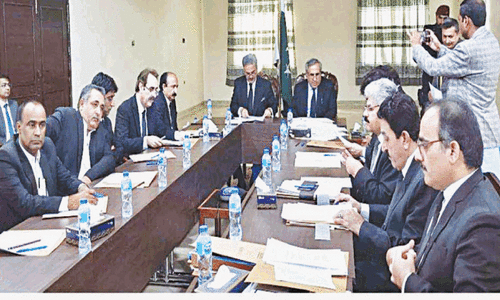
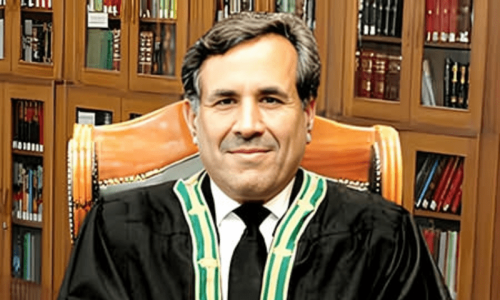
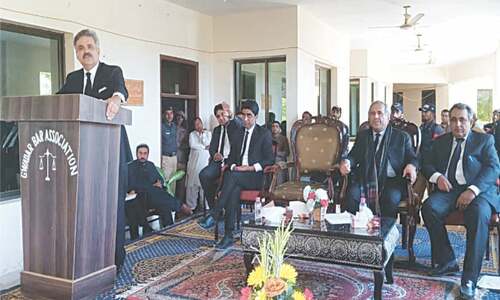
KARACHI: The district judiciary shapes the public perception of the justice sector and plays a pivotal role in either building or eroding trust in the system, the Chief Justice of Pakistan said during a visit to Ghotki, Sindh, on Wednesday.
According to a statement released by the apex court, Justice Yahya Afridi made these observations as part of his initiative to improve service delivery and promote equitable access to justice in remore regions of the country.
Chief Justice of Sindh High Court (SHC) Mohammad Shafi Siddiqui and registrars of the Supreme Court and the SHC accompanied Justice Yahya Afridi.
The CJP urged the high courts to give priority to the placement of skilled judicial officers in remote districts of the country and ensure their tenures are consistent and adequately supported.
The CJP also assured judicial officers of subordinate judiciary that comprehensive steps would be taken to foster a supportive work environment. This would go a long way to enhancing their safety, dignity and access to essential resources.
Justice Afridi interacted with the district & sessions judges as well as representatives of bar associations from Ghotki, Kashmore, Kambar Shahdadkot, Shikarpur, Jacobabad, Larkana, Sukkur, Khairpur and Naushahro Feroze.
He emphasised that the apex court was concerned about access to justice in remote and underprivileged districts in the country.
It is the constitutional obligation of all judges, as mentioned in their oath, to dispense justice at all levels, particularly at the grassroots, because the district judiciary is the first formal forum of litigation where litigants bring their cases, he added.
Dealing with litigants
Chief Justice Yahya Afridi further called upon judges and other members of the legal fraternity to treat litigants with decency and welcome them with a smiling face, kindness, and empathy since these gestures reinforce trust in the judiciary.
He was of the view that such an approach ensures that courts are not seen as merely halls of law but also as beacons of hope and justice for all.
In order to further empower judicial officers in these areas, the CJP proposed several key initiatives, including prioritising foreign training programmes and professional development opportunities through the Law and Justice Commission of Pakistan.
Justice Afridi emphasised the establishment of e-campus facilities for uninterrupted learning and the creation of a framework recognising postings in remote districts as a mark of distinction.
He suggested the introduction of a video link facility to facilitate lawyers in order to bridge geographical barriers and improve access to justice.
Published in Dawn, December 19th, 2024