Canada PM Trudeau bows out with resignation announcement amid plunging popularity


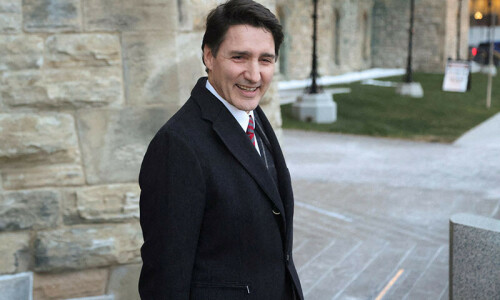
Canadian Prime Minister Justin Trudeau announced on Monday that he will step down as leader of the ruling Liberals after nine years in office but will stay on in his post until the party chooses a replacement.
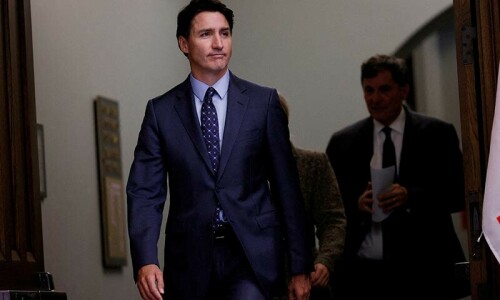
Trudeau, under heavy pressure from Liberal legislators to quit amid polls showing the party will be crushed at the next election, said at a news conference that parliament would be suspended until March 24.
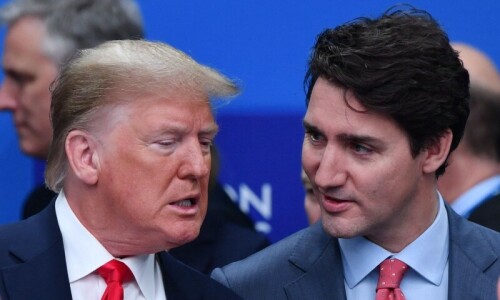
That means an election is unlikely to be held before May and Trudeau will still be prime minister when US President-elect Donald Trump — who has threatened tariffs that would cripple Canada’s economy — takes office on January 20.
“This country deserves a real choice in the next election, and it has become clear to me that if I’m having to fight internal battles, I cannot be the best option in that election,” Trudeau said.
Trudeau, 53, took office in November 2015 and won reelection twice, becoming one of Canada’s longest-serving prime ministers.
But his popularity started dipping two years ago amid public anger over high prices and a housing shortage, and his fortunes never recovered.
Polls show the Liberals will badly lose to the official opposition Conservatives in an election that must be held by late October, regardless of who the leader is.
Parliament was due to resume on Jan 27 and opposition parties had vowed to bring down the government as soon as they could, most likely at the end of March.
But if parliament does not return until March 24, the earliest they could present a non-confidence motion would be sometime in May.
Trudeau said he had asked Canada’s governor general, the representative of King Charles in the country, to prorogue parliament and she had granted that request.
Trudeau had until recently been able to fend off Liberal legislators worried about the poor showing in polls and the loss of safe seats in two special elections last year.
But calls for him to step aside have soared since last month, when he tried to demote Finance Minister Chrystia Freeland, one of his closest cabinet allies, after she pushed back against his proposals for more spending.
Freeland quit instead and penned a letter accusing Trudeau of “political gimmicks” rather than focusing on what was best for the country.
“Removing me from the equation as the leader who will fight the next election for the Liberal Party should also decrease the level of polarisation that we’re seeing right now in the House and in Canadian politics,” Trudeau said.
The Conservatives are led by Pierre Poilievre, a career politician who rose to prominence in early 2022 when he supported truck drivers who took over the centre of Ottawa as part of a protest against Covid-19 vaccine mandates.
Trudeau’s popularity has waned in recent months, with his government narrowly surviving a series of no-confidence votes and critics calling for his resignation.
He has vowed to stay on to guide the Liberals to elections scheduled for October 2025 but has faced further pressure from Trump, who has threatened a 25 per cent tariff on Canadian goods.
Trudeau announced a major shakeup to his cabinet later in December — changing one-third of his team in a bid to settle the political turmoil. In November, he travelled to Florida to meet with Trump at his Mar-a-Lago estate in a bid to head off a trade war.
But since then the president-elect has also landed humiliating blows against Trudeau on social media, repeatedly calling him “governor” of Canada and declaring that the United States’ northern neighbour becoming the 51st US state is a “great idea”.
Coming late to politics after working as a snowboard instructor, bartender, bouncer and teacher, Trudeau was first elected in 2008 to the House of Commons to represent a working-class Montreal neighbourhood.
In his first two terms as prime minister, he brought in Senate reforms, signed a new trade deal with the US and introduced a carbon tax to reduce Canada’s greenhouse gas emissions.
The married father of three also legalised cannabis, held a public inquiry into missing and murdered Indigenous women and passed legislation permitting medically assisted suicide.