Global leaders stand firm behind ICC against Trump sanctions


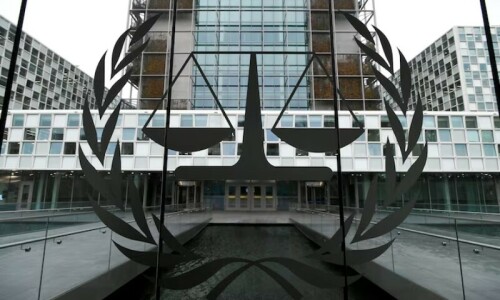
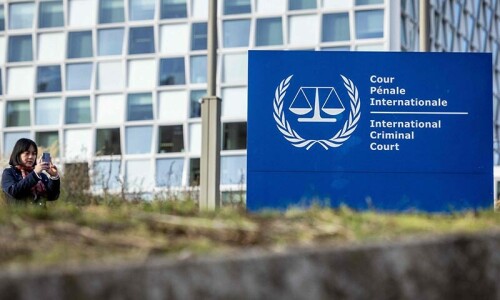
THE HAGUE: Dozens of countries expressed their “unwavering support” for the International Criminal Court (ICC) on Friday, a day after US President Donald Trump authorised potentially far-reaching economic and travel sanctions against the court’s staff.
“We reaffirm our continued and unwavering support for the independence, impartiality and integrity of the ICC,” a group of almost 80 countries said in a joint statement. “The court serves as a vital pillar of the international justice system by ensuring accountability for the most serious international crimes, and justice for victims.”
The 79 signatories came from all parts of the world, but make up only about two-thirds of the 125 member states of the permanent court for the prosecution of war crimes, crimes against humanity, genocide and crimes of aggression.
Among the countries who agreed to the statement were France, Germany and Britain. Among those absent were Australia, the Czech Republic, Hungary and Italy.
Hungarian Prime Minister Viktor Orban had earlier on Friday made it clear he supported Trump’s move, which coincided with a visit to Washington by Israel’s Prime Minister Benjamin Netanyahu, who is wanted by the ICC over the war in Gaza.
Trump’s sanctions target people who work on ICC investigations of US citizens or US allies, such as Israel.
“It’s time for Hungary to review what we’re doing in an international organisation that is under US sanctions! New winds are blowing in international politics. We call it the Trump-tornado,” Orban said on X.
The Czech and Italian governments had no immediate comment on why they had not signed the declaration.
‘Wrong tool’
The court’s host nation, the Netherlands, said it regretted the sanctions and would continue to support the ICC’s work.
“We don’t know the exact impact yet, but it could make the court’s work very hard and possibly impossible in certain areas,” Dutch Prime Minister Dick Schoof told reporters.
“We will do all we can to make sure the court can fulfil its tasks,” he said, adding he had not talked to Trump about the sanctions yet.
German Chancellor Olaf Scholz and other EU leaders said Trump was wrong to impose sanctions on the ICC.
“Sanctions are the wrong tool,” said Scholz. “They jeopardise an institution that is supposed to ensure that the dictators of this world cannot simply persecute people and start wars, and that is very important.”
The ICC itself condemned the sanctions and said it “stands firmly by its personnel and pledges to continue providing justice and hope to millions of innocent victims of atrocities across the world, in all situations before it.”
Asset freezes, travel bans
Court officials convened meetings in The Hague on Friday to discuss the implications of the sanctions, a source told Reuters on condition of anonymity.
The US sanctions include freezing any US assets of those designated and barring them and their families from visiting the United States.
It was unclear how quickly the US would announce names of people sanctioned. During the first Trump administration in 2020, Washington imposed sanctions on then-prosecutor Fatou Bensouda and one of her top aides over the ICC’s investigation into alleged war crimes by American troops in Afghanistan.
The United States, China, Russia and Israel are not members of the ICC.
Trump signed the executive order after US Senate Democrats last week blocked a Republican-led effort to pass legislation setting up a sanctions regime targeting the war crimes court.
The court has taken measures to shield staff from possible US sanctions, paying salaries three months in advance, as it braced for financial restrictions that could cripple the war crimes tribunal, sources told Reuters last month.
In December, the court’s president, Judge Tomoko Akane, warned that sanctions would “rapidly undermine the court’s operations in all situations and cases, and jeopardize its very existence”.
Russia has also taken aim at the court. In 2023, the ICC issued an arrest warrant for President Vladimir Putin, accusing him of the war crime of illegally deporting hundreds of children from Ukraine. Russia has banned entry to ICC chief prosecutor Karim Khan and placed him and two ICC judges on its wanted list.
Published in Dawn, February 8th, 2025