India, US agree to resolve trade and tariff rows after Trump-Modi talks


India and the US agreed on Thursday to start talks to clinch an early trade deal and resolve their standoff over tariffs as New Delhi promised to buy more US oil, gas and military equipment and fight illegal immigration.
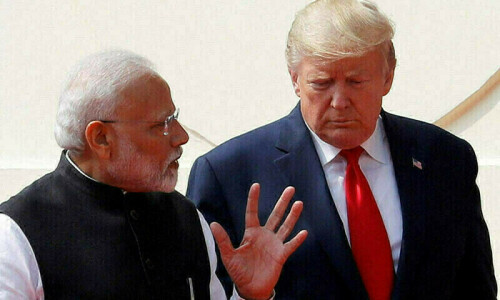
The series of agreements emerged after talks between US President Donald Trump and Indian Prime Minister Narendra Modi at the White House, just hours after Trump railed against the climate for US businesses in India and unveiled a roadmap for reciprocal tariffs on countries that put duties on US imports.
“Prime Minister Modi recently announced the reductions to India’s unfair, very strong tariffs that limit us access to the Indian market, very strongly,” Trump said. “And really it’s a big problem I must say.”
The deal to resolve trade concerns could be done within the next seven months, said India’s Foreign Secretary Vikram Misri.
A joint statement after the meeting said Washington welcomed New Delhi’s recent steps to lower tariffs on select US products and increase market access to US farm products while seeking to negotiate the initial segments of a trade deal by the fall of 2025.
While both leaders “had their perspectives” on tariffs, “what is more remarkable … is the fact that we have a way forward on this issue,” Misri said.
Some of the leaders’ agreements are aspirational: India wants to increase by “billions of dollars” its purchases of US defence equipment and may make Washington the “number one supplier” of oil and gas, Trump said at a joint press conference with Modi.
And Delhi wants to double trade with Washington by 2030, Modi said. Long-planned cooperation on nuclear energy, also discussed by the leaders, faces ongoing legal challenges.
“We’re also paving the way to ultimately provide India with the F-35 stealth fighters,” said Trump.
Misri, the Indian official, later said the F-35 deal was a proposal at this point, with no formal process underway. The White House did not respond to a request for comment on any deal.
What Trump wants
Although Trump had a warm relationship with Modi in his first term, he again said on Thursday that India’s tariffs were “very high” and promised to match them, even after his earlier levies on steel and aluminium hit metal-producing India particularly hard.
“We are being reciprocal with India,” Trump said during the press conference. “Whatever India charges, we charge them.”
Modi vowed to protect India’s interests.
“One thing that I deeply appreciate, and I learn from President Trump, is that he keeps the national interest supreme,” Modi said. “Like him, I also keep the national interest of India at the top of everything else.”
The two leaders praised each other and agreed to deepen security cooperation in the Indo-Pacific, a thinly veiled reference to competition with China, as well as to start joint production on technologies like artificial intelligence.
Asked before the meeting about the steps India was taking, one source described it as a “gift” for Trump designed to lower trade tensions. A Trump aide said that the president sees defence and energy sales to India lowering the US trade deficit.
India’s energy purchases from the US could go up to $25 billion in the near future from $15bn last year, India’s Misri said, adding that this could contribute to reducing the trade deficit.
Tariffs will continue to dominate the two countries’ relationship, said Richard Rossow, head of the India program at the Centre for Strategic and International Studies, a think tank.
“It’s going to be a boxing match,” he said. “India is willing to take a few hits, but there’s a limit.” The US has a $45.6bn trade deficit with India. Overall, the US trade-weighted average tariff rate has been about 2.2 per cent, according to World Trade Organisation data, compared with India’s 12pc.
Fight illegal immigration
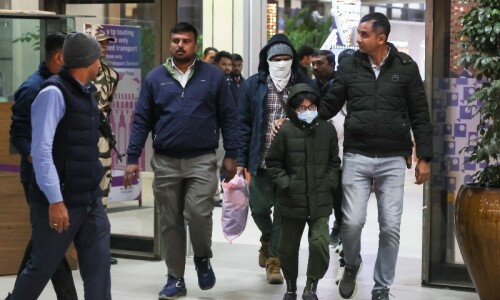
Trump wants more help from India on unauthorised immigration. India is a major source of immigrants to the United States, including a large number in the tech industry on work visas and others in the US illegally.
The joint statement said the two countries agreed to aggressively address illegal immigration and human trafficking by strengthening law enforcement cooperation.
India may prove critical to Trump’s strategy to thwart China, which many in his administration see as the top US rival. India is wary of neighbouring China’s military buildup and competes for many of the same markets.
Modi also worries that Trump could cut a deal with China that excludes India, according to Mukesh Aghi, president of the US-India Strategic Partnership Forum lobbying group.
India has continued its ties with Russia as it carries out its war with Ukraine. India has remained a major consumer of Russian energy, for instance, while the West has worked to cut its own consumption since the war started.
“The world had this thinking that India somehow is a neutral country in this whole process,” said Modi. “But this is not true. India has a side, and that side is of peace.”