WASHINGTON: US President Donald Trump announced plans Thursday for sweeping “reciprocal tariffs” hitting both allies and competitors, in a dramatic escalation of an international trade war that economists warn could fuel inflation at home.
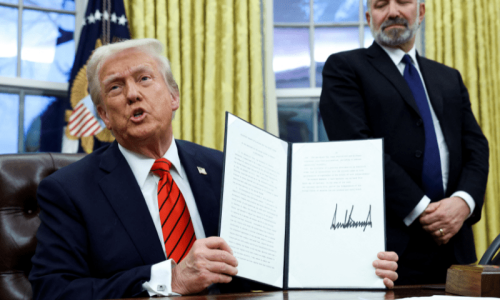
Speaking in the Oval Office, Trump said he had decided to impose the reciprocal duties, telling reporters that US allies were often “worse than our enemies” on trade issues.
The levies would be tailored to each US trading partner and consider factors including value added tax (VAT).
Trump has announced a broad range of tariffs targeting some of the biggest US trading partners since taking office, arguing that they would help tackle unfair practices — and in some cases using the threats to influence policy.
The president has referred to tariffs as a way to raise revenue, remedy trade imbalances and pressure countries to act on US concerns.
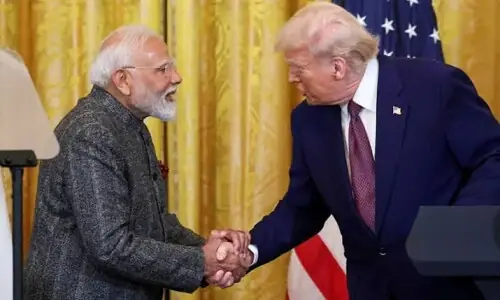
Trump’s announcement came hours before he was due to meet Indian Prime Minister Narendra Modi in Washington.
It remains unclear when exactly the tariffs would take effect, if imposed.
Analysts have warned that reciprocal duties could bring a broad tariff hike to emerging market economies such as India and Thailand, which tend to have higher effective tariff rates on US products.
Countries such as South Korea that have trade deals with Washington are less at risk from this move, analysts believe.
Inflation concerns
Cost-of-living pressures were a key issue in the November election that saw Trump sweep to power, and the Republican has promised to swiftly reduce prices.
But economists caution that sweeping tariffs on US imports would likely boost inflation, not reduce it, in the near term and could weigh on growth eventually.
Trump’s nominee for commerce secretary Howard Lutnick, however, has pushed back on the idea that duties would cause widespread inflation, even as certain costs might rise.
Trump’s deputy chief of staff for policy Stephen Miller previously said countries use the VAT to get an unfair trade advantage, although analysts have challenged this characterization.
During election campaigning, Trump promised: “An eye for an eye, a tariff for a tariff, same exact amount.” For example, if India imposes a 25-per cent tariff on US autos, Washington will have a 25 per cent tariff as well on imports of autos from India, explained a Nomura report this week.
The consideration of non-tariff factors might shift this calculus.
Modi will hold talks with Trump on Thursday and New Delhi offered some quick tariff concessions ahead of his visit, including on high-end motorcycles.
“Trump’s objective of implementing reciprocal tariffs is to ensure fair treatment for US exports, which could indirectly also address US trade imbalances with partner countries,” analysts at Nomura said.
Among Asian economies, India has a 9.5-per cent weighted average effective tariff on US exports, while there is a three-per cent rate on India’s exports to the United States.
Thailand has a 6.2-per cent rate and China a 7.1pc rate on US products, Nomura noted.
Higher tariffs are often imposed by poorer countries, who use them as a tool for revenue and protection because they have fewer resources to impose non-tariff barriers, Cato Institute’s Scott Lincicome earlier said.
Published in Dawn, February 14th, 2025