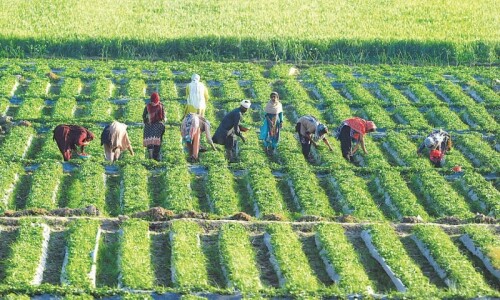
ISLAMABAD: Nuclear science has helped Pakistan achieve self-sufficiency in mung bean production, as most varieties grown in the country have been developed by the Nuclear Institute for Agriculture and Biology (NIAB), in collaboration with the joint FAO-IAEA Centre for Nuclear Techniques in Food and Agriculture.
These varieties have improved crop yields, enhanced disease resistance and enhanced nutritional profile.
The two varieties released in 2021 — NIAB Mung 2021 (NM-2021) and Abbas Mung — were grown on about 70 per cent of Pakistan’s mung bean land area that year, making a substantial contribution to the country’s food security and economy, the IAEA states in its latest bulletin.
Mung bean is one of the most important Kharif pulse crops in Pakistan. It is mainly grown in southern Punjab and Sindh. Punjab is the major mung bean growing province that alone accounts for 80pc area and production.
While the Abbas Mung variety produces medium-sized beans and is known for its culinary qualities, the NM-2021 variety has high nutritional qualities and is distinguished by its large bean size.
With latest varieties, country becomes self-sufficient in mung bean production
The IAEA says more than 3,400 new varieties of over 230 plant species have been produced to-date using radiation-induced genetic variation and mutation breeding, including many food crops, ornamental plants and trees used by farmers in 75 countries.
IAEA DG Rafael Mariano Grossi during his meetings with Prime Minister Shehbaz Sharif and Foreign Minister Ishaq Dar last week discussed nuclear energy’s role in climate change mitigation, nuclear techniques and applications used in agriculture, food preservation and industry besides financing of nuclear power and peaceful uses of nuclear technology.
Since the mung bean varieties developed by NIAB have a yield per hectare that is more than twice that of the previous varieties, it would effectively double the production of mung bean, helping to meet food and nutrition needs. Pulses such as chickpea, mung bean and lentil are staples of Pakistani cuisine.
Nuclear mutation breeding techniques, which have been applied since the 1930s to speed up the process of developing and selecting interesting agronomic traits, use plants’ own genetic makeup to mimic the natural process of spontaneous mutation. The mutation process results in random genetic variations, which give rise to plants with new useful traits.
In 2022, nearly a million hectares of farmland were submerged in massive and deadly floods, severely compromising the mung bean harvest in Punjab and causing a shortage.
However, Muhammad Jawad Asghar, a senior scientist in the mung bean group at NIAB’s Plant Breeding and Genetics Division, is optimistic about the future of mung bean farming in Pakistan: “It’s not all over. This is an opportunity to do two things: maintain self-sufficiency and produce even more,” he says.
Besides mung bean, chickpea is an ingredient that plays an important role in many Pakistani cuisine recipes. In 2021, Pakistan was the world’s seventh largest producer of chickpeas by volume, but local farmers were getting low yields relative to the area under cultivation.
Anupama J. Hingane, a plant breeder and geneticist at the Joint FAO/IAEA Centre’s Plant Breeding and Genetics Laboratory, explains: “The results of the ongoing CRP pave the way for enhancing insect resistance in legumes using nuclear techniques. This advancement offers a sustainable solution for pest control and yield protection in legumes, with the potential to revolutionise their cultivation.”
In March 2023, the Punjab Seed Board released PRI-NIAB Mung, a new multi-purpose variety that matures faster, for commercial release. NIAB also hopes to increase mung bean’s tolerance to herbicides and insects.
Within NIAB’s chickpea group, the focus has been on improving heat tolerance.
A seed tracking and tracing system has also been rolled out.
Published in Dawn, February 17th, 2025