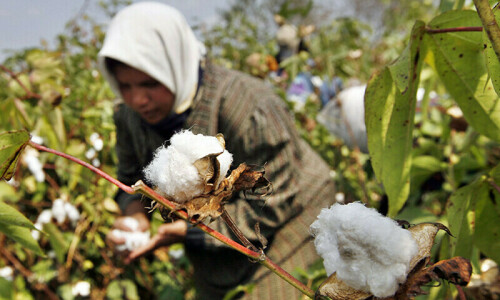
LAHORE: The local cotton industry is facing a severe crisis due to unfavourable import policies and adverse weather conditions.
The situation has raised concerns about a significant decline in the production of white lint this year.
The government’s import policies have encouraged textile mills to import cotton and yarn instead of purchasing them domestically. This has led to a sharp decline in the prices of local cotton and un-ginned cotton (phutti), causing financial difficulties for cotton growers as well as ginning factories.
In addition to the import policies, unfavourable weather conditions have also taken a toll on cotton production. Unexpected rains in February and March last year, followed by heatwaves and further rains in July and September, have severely affected the germination of cotton seeds. The germination rate has dropped to 30-40 per cent, much lower than the required 70pc to 75pc for certified seeds.
To address the seed germination issue, Prime Minister Shehbaz Sharif directed the National Seed Development and Regulatory Authority to hold a meeting with stakeholders, including the Seed Association of Pakistan. The meeting will discuss ways to ensure the availability of certified cotton seeds to farmers.
The Senate Standing Committee on National Food Security and Research had met last week in Lahore and warned the All-Pakistan Textile Mills Association (Aptma) of legal action against those Aptma members defaulting on payment of cess on the imported cotton.
Defaulting millers
At least Rs1 billion is outstanding against the defaulting millers on the imported cotton, while cess amounting to Rs2.5bn is pending on the local purchase of cotton. This has plunged the Pakistan Central Cotton Committee (PCCC) into a financial crisis and severely affected research work. Even employees of the Central Cotton Research Institute (CCRI) in Multan could not be paid salaries for several months.
Sajid Mahmood, head of the technology transfer department at the CCRI, Multan, expressed deep concern over the ongoing financial crisis due to the non-payment of the cotton cess by the textile industry since 2016.
Climate change
Cotton Ginners Forum Chairman Ihsanul Haq has said Pakistan is one of the most affected countries by global climate change. He expressed concerns about the impact of the current crisis on cotton cultivation and the potential for a record decline in production this year.
Published in Dawn, February 17th, 2025