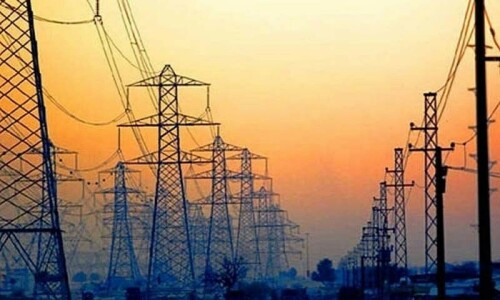
Consumers brace for costly power in summer


ISLAMABAD: The government on Thursday hinted at higher electricity prices in the coming summer owing to lower-than-usual water availability for hydropower and the resultant greater dependence on imported fuels.
During a public hearing on Rs2 per unit negative fuel cost adjustment (FCA) for electricity consumed in January, it was officially reported that a negative FCA of Rs1.23 per unit was currently (billing month February) applicable to consumers of ex-Wapda distribution companies (Discos). Therefore, there would be only 77 paise per unit “decrease for consumers” in March.
National Electric Power Regulatory Authority (Nepra) Chairman Waseem Mukhtar asked about the plan to meet the summer demand given fewer rain and snowfalls throughout winter.
The senior management of the National Power Control Centre (NPCC) told Nepra that current storage in reservoirs and less than projected snowfall in the mountains do not bode well for the power sector in the coming summer months.
Nepra asks for plans to meet rising demand; approves 77-paisa refund
They added that this would mean greater reliance on imported regasified liquefied natural gas (RLNG) for power generation, which would be more expensive than hydropower.
Therefore, Nepra invited the Wapda chairman for a detailed briefing on the overall hydropower availability in the coming months.
The hearing was told that power demand was 4.4pc lower than projected for January in the reference tariff while it was about 2pc lower compared to January last year.
Cumulatively, a 3.3pc decrease was reported in the first seven months of 2024-25. Significant reductions were witnessed in electricity consumption in the industrial and agriculture sectors.
Central Power Purchasing Agency’s Rehan Akhtar attributed the decline in agriculture to the shifting of tubewells to solar power, and the reduction in industrial sector consumption had other underlying factors, as evident from the fall in industrial output.
During the hearing, the Power Division suggested the application of negative FCA on domestic users of less than 300 units monthly consumption and agriculture consumers, saying a formal letter had also been written to Nepra so that the benefit of lower fuel cost should reach all the consumers.
This will be 7th consecutive monthly decline in fuel cost mainly because of substantially higher costs allowed by Nepra through a 20pc increase in base tariff effective July 1, 2024. About 71pc of the total power supply during January flowed from domestic fuel sources, almost 15pc of that at zero fuel cost.
The CPPA said about 8,153 GWh of electricity was generated at an estimated fuel expenditure of Rs88bn (Rs10.79 per unit) in January, of which 7,816GWh energy was delivered to Discos at a cost of Rs86bn (at Rs11 per unit).
Published in Dawn, February 28th, 2025