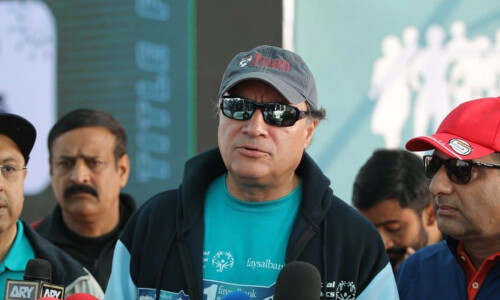
• Aurangzeb launches Parwaaz Green Action Bond; says country recognises climate change as existential threat
• PM Shehbaz says govt actively pursuing policies that integrate climate action across all sectors
• Earth Hour to be observed at 8:30 tonight
ISLAMABAD: Pakistan faces a finance gap and a lack of technical capacity in its fight against climate change, but the government is actively pursuing policies that integrate climate action across all sectors.
This was the gist of separate remarks made by Finance Minister Muhammad Aurangzeb and Prime Minister Shehbaz Sharif, on Friday.
Speaking at a ceremony held to mark the World Day of Glaciers at NDMA Headquarters on Friday, the finance minister said that sustainable economic and environmental growth were correlated, and reiterated the government’s commitment to promoting environmentally stable growth.
He highlighted Pakistan’s growing recognition of climate change as an existential threat, citing concerns such as severe flooding and escalating pollution levels in major cities.
Recalling the ‘super floods’ of 2022, he called them a terrible example of environmental imbalance, saying that it had been identified as a major challenge for the future.
He said that in order to achieve environmental sustainability, the country needed short, medium and long-term policies, as there was not enough time to rely on long-term policies alone.
Mr Aurangzeb also pointed out that glaciers in the northern regions of the country were central for the Pakistani economy, and at least 10,000 out of 13,000 glaciers were currently at risk.
In order to deal with the threats posed by melting of glaciers, a monitoring system and glacier protection strategy would be required for their conservation, he said.
Referring to the Country Partnership Framework (CPF) for Pakistan, he said that in the 10-year economic reform programme being rolled out with the support of the World Bank, environmental challenges are being given more significance.
Stressing that at present there was a finance gap to deal with climate change, the minister said the government would use all available resources to deal with this important challenge.
The minister said the country had achieved macroeconomic stability, adding that in the future, all environment-friendly measures will be taken for sustainable economic growth, and the government will provide ample resources to relevant institutions in this regard.
Green Action Bond launched
Later in the day, the finance minister launched the Parwaaz Green Action Bond, which marks a significant step toward addressing climate change and securing sustainable financing.
The Green Action Bond builds upon Pakistan’s earlier success with the Wapda Green Bond, which saw significant investor interest and was oversubscribed six times. The new bond aims to attract both local and international financing to support green projects.
Speaking at a signing ceremony, Mr Aurangzeb stressed the need to translate climate awareness into actionable solutions.
He also recalled recent discussions with the International Monetary Fund (IMF) on the Climate Resiliency Fund, describing them as promising steps toward securing vital funding.
Mr Aurangzeb acknowledged the need for structural enablers such as a well-defined bond yield curve, secondary market liquidity, and a robust green taxonomy framework.
He welcomed the State Bank of Pakistan’s initiative to introduce such a Green Taxonomy framework, which will standardise project assessments, monitoring, and reporting at an international level.
Earth Hour message
Meanwhile, in his message on Earth Hour day, which will be observed in Pakistan at 8:30pm today (Saturday), the prime minister said the government was actively pursuing policies that integrate climate action across all sectors, with initiatives designed to build resilience and sustainability.
“Programmes like Recharge Pakistan are restoring ecosystems, while policies such as the National Adaptation Plan (2023) and National Clean Air Policy (2023) provide a strategic roadmap for a cleaner, more sustainable future.”
“Despite contributing less than 1pc to global greenhouse gas emissions, Pakistan is among the most climate-vulnerable countries. We have witnessed devastating floods, scorching heatwaves, and prolonged droughts — events that threaten millions of lives, food security, water resources, and urban infrastructure,” he noted.
In his message, the prime minister said: “Our commitment to renewable energy expansion, plastic waste reduction, and green job creation is laying the foundation for long-term environmental stewardship. However, policies alone are not enough — true change begins at home. Every action, no matter how small, strengthens the collective momentum toward a sustainable tomorrow.”
With input from APP
Published in Dawn, March 22nd, 2025